What to talk about when there is nothing to talk about.
From theatrical practice.
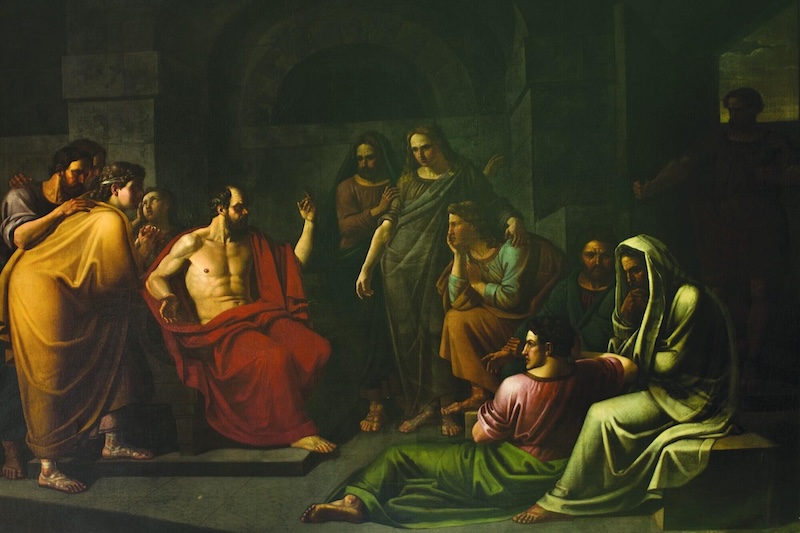
In the 5th century BCE, Socrates established and Plato described a powerful method for discovering the truth—dialogue, in which logic triumphs over misconceptions and prejudices. Dialogue is not an argument: “I am right, you are wrong,” “I am wise and righteous, you are ignorant and wicked.” The goal is not victory, but joint participation in understanding and explaining a phenomenon or idea.
Socrates did not begin with a lecture: “I know that I know nothing. Explain it to me.” Soon, his interlocutor would reach an impasse and be forced to admit his ignorance. At the very least, doubts would arise, along with a desire to understand. The Socratic dialogue did not always work, even in Ancient Greece, where Alexander the Great treated the homeless Diogenes with respect, and a hetaera did not demand payment from the philosopher for her services. One could be taken for a madman, driven away, and beaten. Xanthippe, Socrates’ wife, won an argument with her husband by pouring a chamber pot over his head.
At all times, regardless of knowledge or intellectual merits, it is impossible to prove a point if one’s interlocutor is foolish and fanatically convinced of his own superiority, driven by bitterness or his own sense of inferiority. Noah spent 120 years building the Ark to save people and preached God’s will, but no one listened to him. Moses failed to convince Pharaoh, and he could not persuade the Jews without God’s help. The biblical prophets and sages were not listened to. Socrates failed to convince the Athenian court. Jesus was not saved by his logic and knowledge. The examples are endless.
Shaking the opinion of a contemporary raised in liberal democracy and armed with a smartphone is a dead-end task. Social media and online comments are full of curses and insults; facts and logic cannot stand up to unpunished lies and arrogance. Intellectual superiority breeds hostility rather than respect. The less knowledge and reason one has, the weaker one’s position and self-esteem, the more aggressive the attack.
Wittgenstein believed that the limits of thought are determined by the limits of language; “Whereof one cannot speak, thereof one must be silent.” Derrida created a theory of rational dialogue through the deconstruction of language and meaning, destroying the idea of objective, neutral knowledge; one can never reach the final meaning. Heidegger devised a theory of knowledge in which being dominates, rather than reason and idea.
The greatest philosophers of the modern era—the Jews Wittgenstein and Derrida, who renounced Judaism, and Heidegger, a German from a Catholic family, a member of the Nazi Party, an anti-Semite with a Protestant wife and a Jewish mistress, Hannah Arendt—despite all their differences, share a commonality: the spirit and practice of the Talmud—the eternal movement of knowledge and thought toward an incomprehensible final truth. The process is more important than the result.
Happy are those who know no doubt. For them, everything is clear. They know what must be done and how. In debate, they are invincible. The Gospel says: “Do not cast your pearls before swine, lest they trample them underfoot and turn to attack you.” ” Kabbalah puts it very bluntly: a serious conversation is possible only with those who are capable, willing, and eager to understand. Otherwise, it is only harmful.
Hegel has an essay titled “Who Thinks Abstractly”; its essence is that a philosopher cannot defeat a market vendor. Bertrand Russell: “Fools and fanatics are always certain of themselves, while wise people are full of doubts.” Mark Twain: “Never argue with stupid people. They’ll drag you down to their level.” Dostoevsky: “A narrow-minded person immediately finds an explanation for everything.”
How many people, unaware of Schopenhauer’s name, follow his sarcastic advice: “Get personal, insult, be rude. It’s your last chance to win.” According to Machiavelli, a debate is not a search for truth but a war; one wins by the result, not by proof. These tactics are widely used by politicians, party propagandists in the media, and embittered losers.
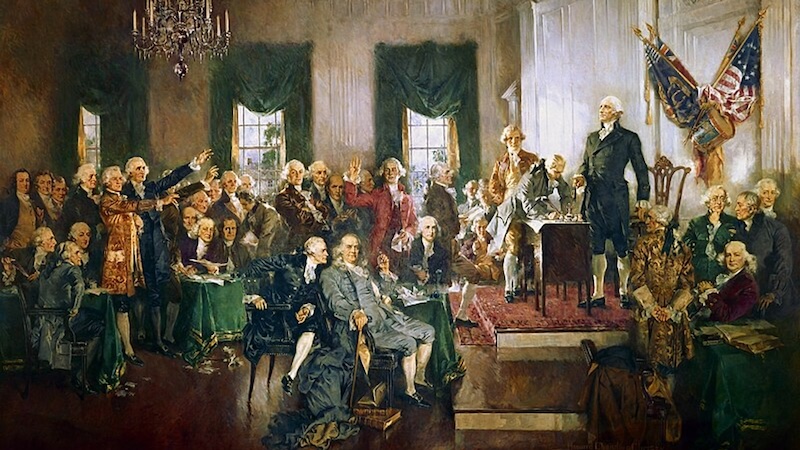
Until recently, the central idea of political demagoguery was a broad public dialogue in which all parties could express their views on the common good and justice and reach agreement and understanding. The idea of civic dialogue originated from the “social contract” of Hobbes, Locke, and Rousseau, which formed the basis of the U.S. Constitution. In 1784, at the Constitutional Convention in Philadelphia, representatives of various beliefs and interests debated and argued for four months until they reached compromises.
But even a brilliant mind is not always a guarantee of productive discussion. A classic example is the televised debate between the Catholic intellectual William Buckley, the father of American conservatism, and Gore Vidal, a left-wing liberal and openly gay man. Accusations of Nazism and homosexuality flew, threats of physical violence were made, and lengthy legal battles ensued. Before that, the distinction between “us” and “them” was determined by intellect and fame. They argued without hostility, discussed ideas and creativity, drank together, snorted cocaine, and swapped sexual partners. Afterward—a war without compromise; the conservatives lost.
Perestroika and glasnost shattered the stagnant routine of party ideology and propaganda; a free press emerged, with massive circulations—write wherever and whatever you want. At the same time, Pandora’s box was opened; all norms of shame and conscience were swept away. Anti-Semitism gained legal status.
This phase was vividly reflected by “Arsenal,” a discussion club in Moscow, an arena for gladiators, champions of no-holds-barred combat. The only rule was not to be boring or to spout platitudes; anyone who broke it was kicked out immediately and permanently. Imperialists, statists, patriots, and traditionalists against cosmopolitans, Westernizers, liberals, and market advocates. Shouting and cursing on stage, a raging audience, collective ecstasy, chaos, a carnival unlike anything Brecht, Meyerhold, or Bakhtin had ever known. The rivals understood that they needed each other. A circus, a theater—but vivid and fascinating, with plenty to remember. The Union collapsed, and the club collapsed. It was not the intellectuals who won, but the oligarchs and officials; journalists, academics, and the cultural elite willingly went into their service; the criterion of truth was established—a billion, a palace, a jet, a yacht.
When lawlessness reigned on the ruins of the Soviet Union, it seemed there was an alternative—liberal democracy with freedoms and rights. But having defeated communism, the West did not celebrate for long; internal contradictions proved more complex than external ones.
Obama entered the White House on a promise of a post-partisan America: “There is no liberal or conservative America; there is the United States of America.” Today, Obama’s camp is waging a war to destroy Trump’s camp. Alarmists speak of the threat of civil war. The divide has permeated every sphere of life and thought. Changing or rejecting one’s religion, mixed-race or alternative marriages, and marital infidelity are not considered as great a sin as belonging to the other political camp. But there is no unity even within the camps.
When it comes to the question of which country people want and can live in, and in which they have no place, discussion will not resolve the issue. Liberals, who speak most of all about public dialogue, inclusivity, and freedom of speech, are militant obscurantists, purposefully and systematically suppressing dissent, having turned education and the media—even the courts—into instruments of political struggle.
There is Obama’s country and Trump’s country. Obama and Trump did not build them; they merely identified them. The contradiction can be described without mentioning specific names. Something similar has occurred throughout history. The Red and White Roses, Catholics and Huguenots, Sunnis and Shiites, Tories and Whigs, Federalists and Anti-Federalists, Reds and Whites, Republicans and Francoists, the Kuomintang and the Maoists… Some conflicts lasted for hundreds of years. On St. Bartholomew’s Day, 30,000 were killed in three days—a massacre over how one is baptized. The heirs of Muhammad have been at war with one another from 632 to the present day; more people have died than in all of the Muslims’ wars against external enemies. In Italy, the bloodshed lasted over 300 years—over the Pope or the Emperor. The Russian Civil War claimed 10 million lives, with millions more perishing in the subsequent repressions. The consequences of the Soviet Union’s collapse look like a continuation of the civil war.
But liberal democracy is also in its death throes. No one is silent; everyone wants to be heard, but the effect is like a theatrical production where a crowd mimics a lively conversation, repeating the phrase: “What is there to talk about when there is nothing to talk about?”
Instead of discussions, discourse has emerged. These are different concepts. Discourse is the language of a social group united by shared values, a common mindset, and norms of existence and behavior. You are either one of us or an outsider. Only those who think and live within the group’s shared paradigm are listened to and heard.
Until very recently, it seemed that artificial intelligence, being superior to humans with their limited knowledge and biases, would find solutions to contentious issues. Today, AI inspires more fear than hope. Steven Rosenbaum, an authority on AI issues, gave a presentation on his book *The Future of Truth*, which expresses optimistic hopes. He made extensive use of AI, but search engines returned a great deal of unreliable and fanciful information and conclusions. Most importantly, AI relies on accumulated data, and if, say, the internet is dominated by hatred and lies regarding Trump and Israel, the computer will produce the same picture.
The pure human mind and AI can prove and disprove anything. Nietzsche shattered old truths with a hammer. AI shatters new paradigms with an algorithm that cannot be trusted. The absolute is unattainable. But truth is revealed when being reveals itself. This is Heidegger’s thought. Hegel is not outdated either: the course of history reveals the truth. For now, the main thing is to bring order to one’s own mind.
Man is a political animal, but not only that
Communication and interaction are imperatives of being and thinking. There is no existence without coexistence. We inevitably have to find compromises and cooperate, if not for the greater good, then to avoid the worst consequences. Even a misanthrope and a narcissist have a need to be noticed, recognized, and liked. Loneliness is a serious factor in depression, intellectual and emotional decline, and suicidal tendencies.
Until recently, one’s social circle was defined by geography and social status. Today, global horizons are open. Social media has 5.5 billion active users, with Facebook alone accounting for 3 billion. Everyone has online friends, yet loneliness is more prevalent than ever before.
The information revolution has turned everyone into a sovereign thinker, capable of advising senators and presidents, explaining life to academics, and presenting their views to the city and the world. The market is flooded with self-help literature promising to teach the art of cooperation and how to please oneself and others. An army of coaches, psychologists, and PR experts teaches how to boost self-esteem, build a successful career, and foster personal relationships.
The liberal paradigm argues that the path to success lies through virtue: high moral standards and concern for the common good. Literary classics reject such illusions and are full of characters who pave their way through deceit, cynicism, and hypocrisy. Balzac created the archetype—Eugène Rastignac. In this vein are Stendhal’s Julien Sorel, Zola’s the Rougons, Thackeray’s Becky Sharp, Maupassant’s Georges Duroy, F. Scott Fitzgerald’s Jay Gatsby, Dreiser’s Frank Cowperwood, Gogol’s Pavel Chichikov, and Tolstoy’s Boris Trubetskoy and Elena Kuragina.
The transformation of socialism into an oligarchy created a gallery of shrewd opportunists. Yesterday’s nomenklatura, gangsters, and those close to them not only became wealthy, they have entered the new power structure, become participants in international forums and elite galas, have their names on cultural institutions and educational establishments, and are shaping new values and a culture in which money and power are the decisive arguments in any discussion. The new power has created its own system of ideas about the social contract: “If you don’t have a billion, get lost…”, “Parliament is no place for debate”, “The state didn’t ask you to have children”, “If they don’t fit into the market, they’re not needed”, “If you disagree, pack your bags, head to the station, and off to Europe”, “Shut down the internet, and that’s it”…
Once you’re on the Forbes list or in the top bureaucracy, you don’t have to worry about charm, manners, or filtering what you say. But most people have to wonder—will they be accepted or rejected? Irrational perception is stronger than rational thought. There are red lines: looks bad, isn’t dressed right, talks too much and too loudly, has the wrong accent, makes an inappropriate joke, doesn’t know how to behave at the table… According to research, emotions account for 90%, intellect for 10%. A smart person ranks 30th, an intellectual 48th. A stupid, uneducated person, of course, isn’t attractive, but if they significantly outshine others in intellect and knowledge, they’ll push people even further away. A Russian classic is Chatsky in Griboyedov’s *Woe from Wit*; in American literature, it’s Carol in Sinclair Lewis’s *Main Street*.
Technological communication has supplanted traditional forms. People spend far more time at the computer and on social media than in face-to-face interaction with relatives and friends. And instead of intellectual and emotional enrichment, technological connections—fueled by anonymity and impunity—multiply aggression, stoke conflicts, and foster psychopathology. The ability to insult someone without getting punched in the face, or facing legal consequences, is an irresistible temptation for a damaged psyche.
Israel and Jews have found themselves at the forefront of online expressions of hatred and threats, ahead of all other nations and peoples. Anti-Semitism on the internet is at its highest level of activity and intensity. Jews are the primary victims of hate speech and online harassment. The internet has brought hatred toward Jews to a global scale. Trying to outargue or dissuade an anti-Semite through logic and education is a hopeless task, though Jewish liberals still pin their hopes on it.
Shmuli Boteach, the “American rabbi,” as the press calls him—an intellectual of the broadest erudition, a brilliant debater who has fought countless public battles and court cases against political opponents and anti-Semites—constantly receives threats of physical violence, has been attacked in America and abroad, yet despite his fame, no one has been punished.
Elizaveta Pipko, the daughter of immigrants from the Soviet Union, actively participated in the election campaigns of Trump and Republican politicians and supports Israel. People write to her and say to her face: “You don’t deserve to live. Hitler should have finished the job.” The education system and the media are stoking anti-Semitism, justifying it as free speech, says Pipko. Anti-Semitism has been normalized and has become political capital.
120 years ago, Dmitry Merezhkovsky wrote “The Coming Boor” — “Ignorance with a University Degree.” “The coming boor will prevail. Not barbarism, but boorishness. Not ignorance, but semi-literacy. Not the brutality of strength, but the audacity of weakness.” Hounded by boors, Mikhail Bulgakov created the image of the proletarian Sharikov, who knows no shame, conscience, or doubt. Massolit and Proletkult have disappeared, but boors are multiplying across the boundless expanses of the internet. Merezhkovsky believed that the boor would prevail through numbers, audacity, vulgarity, and impunity. Fighting is futile; it is a trap. To win, one must become like the boor and outboor him.
The Bible offered salvation: “Blessed is the man who does not walk in the counsel of the wicked,” said King David. Today, this is a call not to live on social media or in front of the TV. To ignore the online troublemaker. To read intelligent books, to listen to serious music. Keep silent about what you do not know, what is beyond your understanding and knowledge. Let go of illusions about quick solutions, the next election, and the right leaders.
The lessons of life’s teachers have not gone out of style. Seneca, “Letters to Lucilius.” Marcus Aurelius, “Meditations.” Pascal, “Pensées”; Montaigne, “Essays.” Schopenhauer, “Aphorisms on the Wisdom of Life.” Camus, “The Myth of Sisyphus.” If you are a believer, every religion contains experience and wisdom; the question is whose mind reflects them.
In the Torah, God repeatedly called the Jews a stiff-necked people. A metaphor derived from the neck of an ox. Interpretations vary. Complimentary: Jews are principled, firm in their convictions, and persistent. But in essence, this is not praise at all: they are stubborn, obstinate, unable to admit they are wrong, and possessed by pride.
Jewish history has seen centuries-long disputes tragic conflicts. The struggle between the Sadducees, Pharisees, Zealots, and Essenes. The Talmud is 700 years old; it was born from the endless discussions of an entire nation that had been deprived of the Temple. The Babylonian Talmud does not replicate the Jerusalem Talmud and is much larger than it. In both, a single line of law yields dozens of opinions. Where Shammai says “no,” Hillel says “yes.” Akiva supported the revolt against Rome, while the majority of the Sanhedrin opposed it. Before Steinsaltz, the Talmud was a book for the select few. Steinsaltz opened it up to everyone, and this sparked protests among the ultra-Orthodox.
Most Jews today do not base their lives and relationships on the Torah and the Talmud. The conflict between religious and secular Jews began during the Enlightenment: to leave the ghetto, to break free from parochial existence and thinking, or to embrace reform and assimilation. Zionists and anti-Zionists have been debating since 1897 whether Jews need their own Israel. Since 1948, there have been disputes and hard feelings between Sabras and Jews of the Diaspora. There are many jokes and anecdotes about Jewish pluralism. Two Jews, three opinions—what a circus, gevelt! Every Jew feels like a prophet on a mission to explain to the world the truth of life.
The intellectual history of the Jewish people is vibrant, rich, and heartwarming across the centuries, but here and now, under current circumstances, history offers no comfort. In the American community and in Israel, public opinion is more divided than ever since the Holocaust. Where can we look for solutions, for answers to our questions? Should we be open to the world, or should we strictly define the boundaries of our existence and thought in order to preserve our nation and identity?
Maimonides had a deep knowledge of Aristotle, Christian scholasticism, and Arab philosophers. Akiva debated with Roman philosophers. Rashi, Ramban, and Hirsch were encyclopedic in their learning and did not shy away from challenges. Rabbi Soloveitchik studied Kant, Kierkegaard, and Bergson—“The Halakhic man does not flee from the world; he conquers it.” Rabbi Schneersohn studied mathematics, physics, and engineering at the university, read Schrödinger, Freud, Jung, Sartre, and Camus, and had a deep understanding of politics.
In academic life, one cannot avoid the anti-Semites Tertullian, Augustine, Aquinas, Luther, Voltaire, Spengler, Proudhon, Heidegger, and Schmitt. One must read Kevin MacDonald, Edward Said, Alexander Dugin, and Oleg Platonov. I knew many fervent dissidents—Russian patriots who said outrageous things about Jews, but their brilliant talent and personality overshadowed everything. It is impossible to understand, but you need to know about Izrael Shamir, a Jew from Novosibirsk who emigrated to Israel, fought in the Yom Kippur War, wrote for leading media outlets, went from being a Zionist to an anti-Zionist, and was baptized. He is a best-selling author and a star of global right-wing forums. Main ideas: Judaism and Zionism = racism, apartheid, a Jewish conspiracy, a world under the control of the Mossad.
You need to know firsthand about your enemies and opponents, the mood on campuses and in the streets, and be prepared for a tough debate if it makes sense and you have an interesting conversation partner. But what should you say to your useful idiots?
In New York, in Brooklyn, in Park Slope, there is a co-op store selling organic products. It has 17,000 members united by a concern for their health. The co-op became famous for its campaign to boycott Israeli products. These products make up a small percentage of sales, but the hysteria is sky-high.
The boycott campaign is led not by a Palestinian activist, but by an elderly Jewish woman, Alice Barr. She is protesting against genocide and apartheid and wants to steer the co-op toward the right side of history. The heated debate has been going on for nearly 30 years; the latest vote was 67% in favor and 31% against the boycott. Absurdity and shame have prevailed, and the events are being widely covered by the mainstream media. The vote can be viewed as a scientific experiment demonstrating that a healthy diet does not contribute to the health of the mind and conscience.
Among Jews who stand in solidarity with the enemies of the Jewish people, there are many intellectuals whom one cannot accuse of ignorance of history or the current situation. Professor Norman Finkelstein, the son of Holocaust survivors and author of numerous publications filled with hatred for Israel and support for its enemies, has gained widespread fame. Professor Omer Bartov, a frequent guest on prime-time TV and an expert on the Holocaust, genocide, and the history of Israel, expresses regret in his new book *What Went Wrong* that Israel is so strong; which is the source of all its troubles. Try explaining to the professor that if Israel were weak, it would be destroyed—this is the open goal of Iran, Hamas, Hezbollah, and their supporters around the world.
Long before the current crisis, the renowned playwright Tony Kushner edited the book *The Struggle Against Zionism*, written by Jewish authors—writers, artists, educators, journalists, and rabbis. We are well acquainted with such literature from Soviet times, but back then, Jewish participation in anti-Israel campaigns was forced; refusal meant losing one’s job, persecution of one’s family, and emigration was impossible. But in America, there is free choice, though there is pressure. At worst, one can remain silent and not participate in the march of the wicked.
Many of the leading columnists at The New York Times are Jewish. But their golden pens serve anti-Israel propaganda, supporting anti-Semites in politics, education, and culture. The American Zionist Organization stated: “The New York Times’ journalism is becoming a weapon against Israel.” . I see no difference between the positions of The New York Times and Al Jazeera in their coverage of the Israeli-Palestinian conflict, but I read the Arab newspaper with an understanding of its role and goals, while The New York Times is beyond my comprehension. Its propaganda mission is not limited to criticizing Israel. It is a denial of the foundations of Western civilization.
There are hundreds of Jewish organizations in America; J Street is not the largest in terms of membership or budget. But it has become the most visible thanks to the favorable attention of the mainstream media and anti-Semitic politicians, who readily cite it as the voice of the Jewish community. J Street is an active participant in pro-Palestinian protests, consisting mainly of college-educated young people. This worldview and behavior cannot be explained by senile dementia or ignorance.
Israeli Ambassador to the U.S. Yehiel Leiter called J Street a cancer on the Jewish community; the American Zionist Organization endorsed this characterization. In my opinion, the diagnosis is inaccurate. J Street, Alice Barr, and anti-Israel Jewish intellectuals are a repulsive caricature, not a serious threat. The main problem with American Jewish community is liberalism and religious reformism that contradicts the essence of Judaism and imposes utopian notions about the world and humanity.
Judging by the news, Israel and the Jews are the central problem of the universe. But there is no doubt that in the near future, the world will come face to face with more serious and far-reaching problems that cannot be solved by anti-Semitic campaigns. Reality, not debate, will enlighten consciousness.
It is more difficult to comprehend and look into the future of world Jewry. Europe will be lost to Jews due to Islamization, low birth rates, and intermarriage. In Israel and America, the future of Jews depends primarily on the relationship between secularists and Orthodox Haredim.
Secular Jews are convinced that the ultra-Orthodox are medieval fanatics, and that in humanity’s bright future they will be nothing more than museum exhibits. This is a very superficial belief. Quite the opposite, in fact. Among Reform, Conservative, and atheist Jews, the birth rate is below replacement level; 60% in intermarriages, which means assimilation and loss of identity within a generation. Only DNA analysis will reveal traces of the past.
Orthodox Jews have 5–6 children, strong families, and a faith that has sustained and saved them for millennia, and remains the meaning and values of life. They are the guardians of the Covenant and the lineage. Secular Jews may hope to solve the problem of anti-Semitism through assimilation, loss of identity, conformity, and conversion. For the Haredim, this is suicide, forbidden by the Torah. Today, secular Jews are in turmoil, in chaos, but the Orthodox, though they bear the brunt of attacks and insults, retain their confidence and faith in the future.
Rabbi Shmuli Boteach has published several brilliant essays on the confrontation between secularists and ultra-Orthodox Jews. On the one hand, there are those who work, pay taxes, study useful professions, make discoveries, and serve in the army. They have many grievances against those who live off taxpayers, refuse to serve in the army, and try to dictate a way of life to everyone.
Opponents believe that one does not have to be Jewish to hold such a worldview and behave in such a way. A Jew without the Torah is not a Jew. The Torah has preserved the Jewish people for thousands of years, and it is the only path ensuring the nation’s salvation. Many Haredim oppose Zionism, believing that the true revival of Israel requires messianic intervention.
Rabbi Shmuli is engaged in a debate with the Satmar Chief Rabbi, Teitelbaum, who believes that secular Zionism contradicts the essence of Judaism and threatens the very essence of Jewish existence. He sees the Holocaust as a demonstration of the consequences of assimilation, and the creation of Israel not as a “miracle” but as a trial that must be endured without losing faith. Shmuli writes that Teitelbaum “provides ammunition to Israel’s theological enemies.” He condemns the Haredim for their ingratitude toward those who pay for their livelihood with taxes and give their lives to defend the Jewish state.
At the same time, Shmuli sees in Teitelbaum a theological giant and writes about him with great respect, a rare example of an intelligent discussion. Shmuli concludes that the division among Jews regarding Zionism has gone so far that it is better to abandon the concept and focus on combating anti-Semitism and supporting Israel.
Shmuli’s fate is a paradox of the life and thought of an intellectual. He was America’s most famous rabbi; now he is the primary target of anti-Semitic hatred and criticism from all sides within the Jewish community. Since childhood, Rebbe Schneerson has been his Rebbe, yet Shmuli has a very strained relationship with Chabad.
To an outsider, a religious Jew in black robes with tzitzit and a tallit appears to lack knowledge and understanding of real life. I had no idea about religious Jews until life brought me into contact with Rebbe Schneerson’s emissaries, who were trying to transport his library out of Moscow. I wrote about the Rebbe and the Hasidim in the mainstream press. I defended them in Pravda and Izvestia against accusations of ritual murder. I was invited to head a department at the newly established Maimonides Jewish Academy, but this was in addition to the two other departments I was already heading, so I didn’t really get deeply involved; the academy was secular, and my course was secular. It was during this time that I read Maimonides for the first time and learned what the Tanakh was.
In New York, I mainly attended Reform and Conservative synagogues. Even with my limited knowledge, it was clear that this had very little to do with Judaism; rather, it distorted it. And in the Orthodox synagogues, although the faith is strong there, I am an outsider; I don’t know Hebrew or the rituals, and I’m not dressed according to the rules.
It so happened that two years ago, a Sephardic yeshiva from Lakewood, New Jersey, moved into the guesthouses across the street from our country home. This small town is home to the intellectual elite of Orthodox Judaism. The largest in America, the “Lakewood Yeshiva” is the Harvard of Judaism. There are also other high-status yeshivas here, both Sephardic and Ashkenazi.
I was stunned by Rabbi Yaakov Harari’s immense erudition, logic, and phenomenal oratory and teaching skills. His workday lasts 14–15 hours. He is always available to his students, who come to him for advice on theological questions and family problems. Harari does not discuss politics or comment on the news. His subjects are eternity, the universe, and the meaning and purpose of existence. This is the most relevant and practical approach. He has a large, wonderful family. During Shavuot, his wife spent three days alone with the children preparing a lavish meal for a hundred people. There are prophets and tzadikim even in our time.
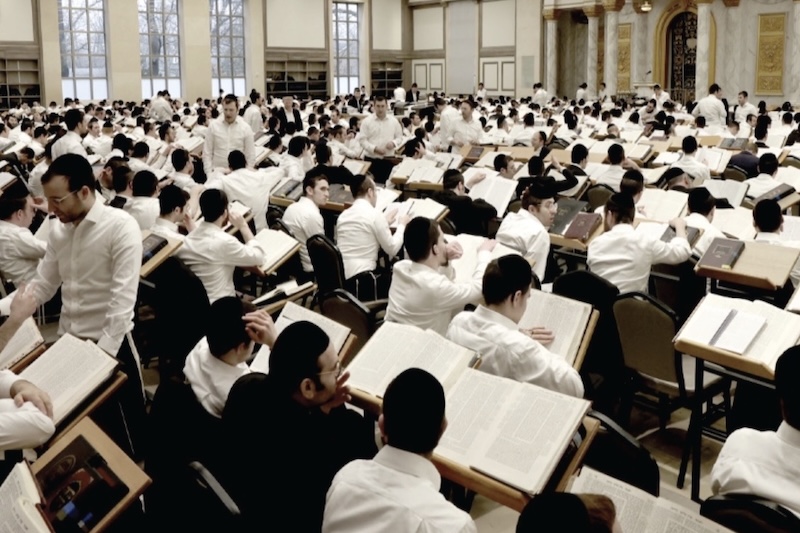
It was a great honor for me to speak to yeshiva students on several occasions and to spend quite a bit of time conversing with them. They are in their 20s and 30s; their school day runs from morning until late at night, with lunch and dinner accompanied by discussions on chapters of the Gemara, Mishnah, Halakha, and Jewish sages. There is no idle chatter. They come to lectures in expensive suits and shoes, wearing snow-white shirts. They show immense respect and gratitude toward their teachers. I have never had students or graduate students like this, and I can only envy their teachers.
Their high work ethic, discipline, and sense of responsibility guarantee that whatever they undertake, they will succeed; that they will not be poisoned by toxic ideologies; and that under any circumstances, they will not lose their sense of purpose and meaning in life.
During Shavuot, a group of black hooligans from New York once again went on a rampage in the town of Deal, New Jersey, where Sephardic Jews from Aleppo, Syria, live. Aleppo was razed to the ground by the Assad regime, ISIS, America, and Russia. Their adaptation to their new country has been successful. Businesses in diamonds, real estate, textiles, and imports are under strict community control. Marriages are exclusively within the community. It is one of the most expensive zip codes in the country. Mansions costing up to $50 million, magnificent private schools, synagogues, restaurants, and beaches.
Many study at the yeshivas in Lakewood. They know Hebrew, French, Arabic, and English. They didn’t attend business schools, didn’t rely on lobbyists, the Federal Reserve, and the Pentagon like corporations do, didn’t plunder the state like Russian oligarchs—they started from scratch in America. They live without Prozac and Viagra. Their foundation is the Torah and the Siddur, which everyone knows as well as a rabbi.
When students told me about their encounters with anti-Semitism, I saw no confusion, fear, or pessimism. They know what is happening in the world and in the country. Faith and spiritual strength give them wisdom, mental health, confidence, and peace of mind.
I do not idealize religious institutions. Many are politicized, with populist rhetoric that appeals neither to the mind nor the heart; at best, they are social clubs. For many, the priority is group isolation; for others, proselytism; for all, fundraising. Many yeshivas do not teach properly reading and writing, nor do they prepare students for real life. Drugs, alcohol, and scandalous behavior have become serious problems.
This makes the example of Lakewood all the more important, and not just for students. I am Ashkenazi, have no religious education, understand Judaism through my own reasoning, having visited a hundred synagogues; I concluded my search among the Sephardim, where I am not one of them and will never be, but I feel I am in the right place at the right time.
Эта рассылка с самыми интересными материалами с нашего сайта. Она приходит к вам на e-mail каждый день по утрам.