Your Life or Someone Else?
The UN has a total staff of over 100,000 employees and a total budget of about 10 billion. Despite the colossal costs and the United States’ special role in the organization’s creation and funding, more than 60% of Americans rate its performance as poor. There is a severe crisis of confidence worldwide regarding the UN’s ability to effectively address issues of war and peace, prevent global threats, and provide aid in disaster situations.
Although the UN’s demographic composition is increasingly shifting toward the Global South, representatives from these regions view the Security Council as a relic of colonialism and World War II and demand that it be reformed in their favor.
Disputes over the effectiveness and legitimacy of the world’s largest international organization cannot be resolved in this article, nor in any other. Time will tell whether it has fulfilled its historical role, whether it is needed under new circumstances, and whether it serves the cause of peace and progress.
But there are aspects of the UN’s existence that are unique and irreplaceable. It is the largest vantage point, reflecting the state of relations, sentiments, and contradictions in a polarized world of chaos and absurdity.
Evidence of this situation comes not only from UN resolutions and delegates’ speeches but also from ongoing demonstrations, rallies, and protests in the area surrounding the UN. For the most part, these actions are related to foreign conflicts and crises, and participants include not only immigrants and foreign visitors to New York but also American citizens concerned about global issues.
During a General Assembly session, there are 20 or more rallies per day. In an average month, there are 30–40. Forty percent are pro-Palestinian demonstrations, 15% concern Russia–Ukraine, and 10% focus on climate change. Other issues include China, Tibet, Ethiopia, Iran, Yemen, and the rights of women and minorities. They mainly gather on weekdays to be seen by thousands of diplomats and tourists.
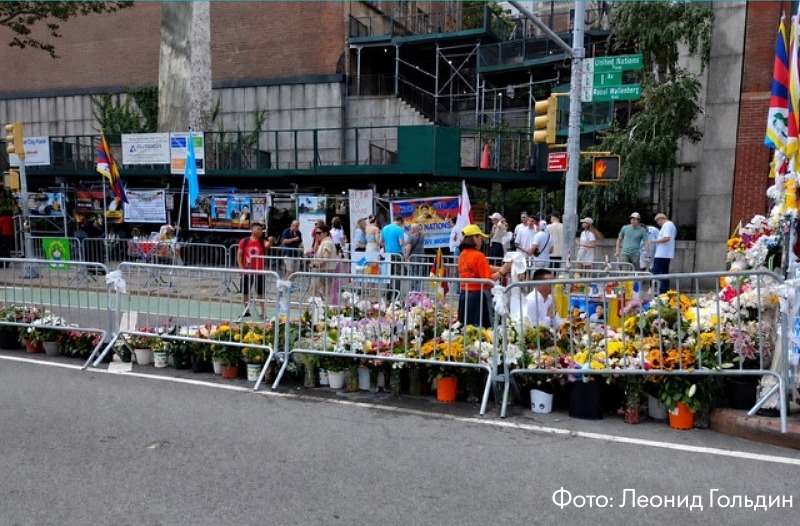
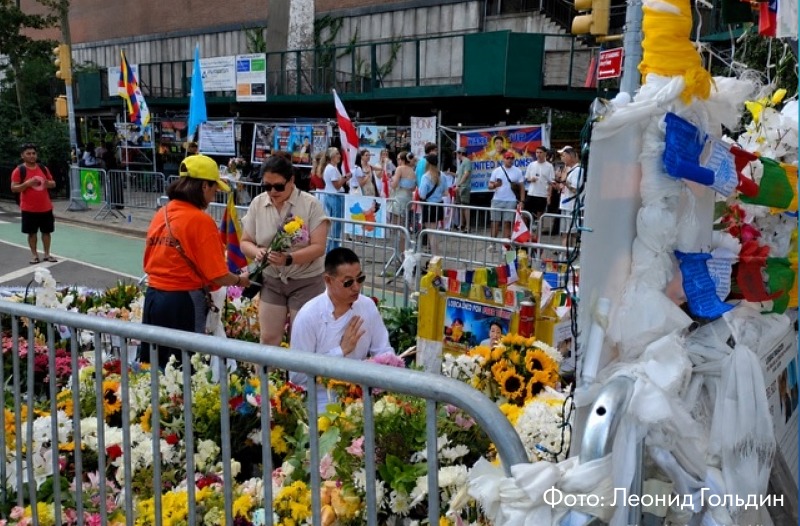
I’ve worked and lived in this area, so I know firsthand what the atmosphere is like at the UN and in its surroundings. Last Saturday was a very hot day; there were no passersby visible around the UN, but opposite the main entrance, Tibetan freedom fighters gathered to stage a public dry hunger strike. University students came to support them.
Across from the UN, behind a police barrier, memorial vigils are constantly held in honor of Pawo Lobga Rangzen, who publicly set himself on fire in front of the UN in protest against China’s occupation of Tibet. There have been 171 such vigils worldwide, and this was the first in the United States. Rangzen was a New York resident and a former monk. He fled Tibet for India and later emigrated to the United States.
The protesters are demanding that the UN take effective action to protect the civil rights of Tibetans to self-determination, the preservation of their national culture and language, and protection from forced assimilation.
I spoke at length with the protest organizers. “What are you hoping for? Amid the West’s divisions and weakening, China is strengthening its global position and openly asserting its claims to Taiwan, a sovereign state; there can be no question of recognizing Tibet’s independence. America won’t go to war over Tibet; no sanctions against China will have any effect; and most countries, as well as the UN, prefer not to get involved in this issue.”
My interlocutors replied that they place their hope in new generations, in goodwill, and in education. They are guided by Buddhist principles, reject hatred and violence, and believe that love, tolerance, and compassion will prevail sooner or later.
This stance is very rare in the modern world. Disagreement and the struggle for rights—for one’s own conception of justice—are typically waged in brutal and violent ways, often involving terror, provocations, and hate speech. To protest and draw attention, people kill their opponents rather than themselves, provoke retaliatory actions, and use their own civilian population as human shields.
Over the past decades, 9 million people have died in ethnic and inter-neighbor conflicts and wars, with the highest death tolls in the Congo, Rwanda, Ethiopia, Sudan, Syria, Yemen, and Iraq. More than 80% of those killed were civilians. According to the UN, there are 120 million refugees worldwide. After the collapse of the Soviet Union, approximately 20 million people fled their homes. Yet Israel remains the focus of global attention and condemnation.
Israel faces more UN condemnatory resolutions than all other countries combined, where genocide, ethnic cleansing, mass rape, and religious persecution are taking place. All attention is focused on the suffering of the Palestinians, which they have brought upon themselves by supporting the terrorist regime of Hamas.
Throughout its history, Israel has lived under terror and the threat of annihilation, yet the UN is convinced that Israel is the greatest war criminal, committing genocide against the Palestinians. Israel is the only country in the world included on the UN’s standing agenda item “The Situation in the Occupied Arab Territories.” After the 1948 war, 260,000 people lived in Gaza; now there are 2.3 million, with a birth rate of 5–6 children per woman. Is this a concentration camp marked by starvation, mass executions, and the extermination of the civilian population?
The voices of Israeli representatives and small pro-Israel groups who come to the UN to express support for the Jewish state go unheard amid an atmosphere of hatred and prejudice.
I would like to believe Buddha and the Tibetan monks that love and compassion will triumph over violence and hatred. So far, life has not confirmed this.
The Torah forbids suicide, although this is precisely what Israel’s haters and liberal critics demand of it. A Jew will not go to the UN to set himself on fire. Judaism obliges us to resist and destroy the evil that threatens life. Jewish liberals do not want to remember this covenant. The Israel Defense Forces fulfill this covenant.
Эта рассылка с самыми интересными материалами с нашего сайта. Она приходит к вам на e-mail каждый день по утрам.