Let me begin with a personal note, one I believe I am entitled to make as a veteran writer with a substantial, diverse, and widely recognized literary career. First in the Soviet Union, then in the United States, and in other countries as well, through translations into a dozen languages. Whether an article, an essay, a short story, or a novel, my publications have invariably stirred controversy, provoked polemics, and occasionally caused outright scandal. One American newspaper even dubbed me “Mr. Scandal,” yet continued to publish me regularly, on the grounds that negative publicity was worth more than positive publicity. One thing I could never complain about was reader indifference. And that goes for my fiction, too.
I thought I would die the author of Three Jews, my feverish St. Petersburg confession, but then I managed to overtake myself with a prophetic novel-cum-treatise, Schrödinger’s Cat. Its principal character is unmistakably recognizable, and his real-life prototype, having recognized himself in the literary character, has been hounding me ever since. But here I am, still alive and kicking — for the time being. The author hopes to outlive his vengeful antihero. Not merely thanks to personal protection, but because my Kremlin ruler has stepped onto history’s minefield by setting himself against the course of history. Such folly does not go unpunished. Just look at Hitler. His fate should serve as a lesson to others, should it not? And yet his admirers and epigones keep turning up, following in his footsteps, oblivious to the inevitable end awaiting them.
What does history teach us? Alas, nothing.
Here in America, I began running a regular column and television segment in the Russian-language media called “Vladimir Soloviev’s Paradoxes.” My premise was that truth begins its journey as a paradox and ends it as a truism. I never had a column by that name in the English-language press, but my paradoxical essays appeared in prestigious newspapers, from The New York Times and The Washington Post to The Wall Street Journal and The Chicago Tribune. And so, faithful to that paradoxical tradition, I continue to write in paradoxes, hoping that a few of them will come true and bring us closer to the truth.
Let us begin with some territorial absurdities that, for some reason, seem to escape everyone’s notice, although they are a textbook case of the Theater of the Absurd.
Russia wants to get, for nothing, that part of the Donetsk region it has been unable to capture by force, despite having launched its campaign many years ago, long before the full-scale invasion of Ukraine, and having sacrificed an astronomical number of its own men in the process. Now it has turned this absurdly pedantic demand — to obtain the Donetsk region within its former administrative boundaries — into a diplomatic ultimatum, attempting to sell the proposition to the American side as well.
To make its case, the Russians produce a map showing them in possession of more than half of this ill-fated, long-suffering land. As the rules of the genre — I mean the Theater of the Absurd — require, the Ukrainians produce their own map, demonstrating that this is not so, and that the Russians inhabit an imaginary reality in which they may well believe, even though a good half of the Donetsk region belongs not to Russia but to Ukraine.
And then, at this trilateral meeting in Abu Dhabi, like a deus ex machina descending onto the stage of an ancient Greek theater, the Supreme Allied Commander Europe, General Alexus Grynkewich, appears and sets the record straight: the Ukrainian map of the battlefield is closer to reality.
The Theater of the Absurd must be carried to its logical conclusion. So here is my advice to my Ukrainian friends: make a counterproposal. Let the Russian fascists hand over to Ukraine the part of the Donetsk region they have occupied.
Why not? Ukrainians have incomparably greater legal and historical rights to the entire Donetsk region than the occupiers.
Give Donetsk Back!
Curtain.
Or take Israel — the miracle of the twentieth century, as defined by Fazil Iskander, my Moscow friend and neighbor in what we used to call the Jewish Ghetto, a writers’ residential enclave near the Aeroport metro station. A miracle it certainly is, and not just of the twentieth century but of the twenty-first as well, given that, like Ukraine, Israel is waging an existential struggle to defend its right to exist against a multitude of enemies from all over the world, sporting Palestinian scarves, waving the flags of a Palestinian state that does not exist, and chanting the antisemitic slogan “From the River to the Sea” — a replacement for the old “We’ll Throw Israel into the Sea.”
Well, look what they have in mind!
But why shouldn’t Israel — and this is my own suggestion to my Israeli friends — come up with a counter-slogan using precisely the same words? After all, the entire territory between the Jordan River and the Mediterranean Sea is, de facto, under Israeli control, while the Arab-populated territories of Judea and Samaria (the West Bank) and Gaza are, in effect, something like Israeli protectorates.
Personally, I see no Palestinian state appearing on the Middle Eastern map in any foreseeable historical future.
Enough of paradoxes. Let us return to reality, which is itself a paradox and an oxymoron. Especially when History itself takes center stage — History with a capital H, naturally. On both theaters of war: the Middle Eastern and the European.
On the European front, I see no historical option other than the restoration of Ukraine within its 1991 borders, recognized and guaranteed to it, among others, by Russia itself. This is not maximalism. It is a historical inevitability.
At this moment, the guarantor of such an outcome is neither the United States nor Europe, but Ukraine itself, albeit with their assistance. The course of world history, together with the military, political, geopolitical, economic, and every other conceivable aspect of the current situation, confirms this historical trend.
Russia and Ukraine are moving in opposite directions, and the balance between them is becoming inversely proportional: Russia is growing weaker, Ukraine stronger. Needless to say, certain global forces, countries, and politicians are contributing to this process, while others are trying to obstruct it. We see these contradictions even within a single country, a single governing team, and even within one and the same politician.
In democracies, of course, such shifts take place through elections. The latest example is Hungary, which, with the change of leadership from Orbán to Magyar, has made a complete 180-degree turn in its political course.
But it is not only democracies that change course. Totalitarian regimes do so as well. Take Belarus, for example, the homeland of my ancestors, incidentally. And this under one and the same leader. Alexander Lukashenko, or Batka, as he is affectionately known, has an unmistakable feel for History. He keeps his finger to the wind, not merely to avoid ending up like Mussolini, but perhaps more in the manner of Generalissimo Franco. Franco did everything he could to avoid becoming too closely allied with Hitler and refused to let German troops cross Spain on their way to Gibraltar. “That damned Jew!” Hitler is said to have exclaimed in fury.
In Batka’s case, I will give Trump his due. His envoys, both openly and behind the scenes, are doing everything possible to pry Belarus away from Russia. The exchange of political prisoners for sanctions relief is one example.
But what matters far more is the impending geopolitical shift. I believe Belarus will be the next country Russia loses, following Venezuela, Syria, Hungary, Serbia, and others. This will work primarily to Ukraine’s advantage.
The leader of the Russian fascist regime has set himself against History and has, de facto, fallen beneath its wheel, just as Hitler did — crushed by that wheel both de facto and de jure. I say this, needless to add, without the slightest sympathy for either of them, and purely ironically.
This is not my paradox, however, but Erich Maria Remarque’s, from Shadows in Paradise:
“Poor Nazis. They had a terrible time of it. All they ever wanted was peace, nothing more.”
“What?”
“Exactly. If the world had agreed to dance to Hitler’s tune, there would have been no war.”
Hitler — and Hitlerism — ended up beneath the wheel of history. It took the Second World War to bring that about. Stalinism was a different matter: it ended with Stalin’s death. Possibly a violent one — his comrades may have lent a hand.
And yet, toward the end of his life, the tyrant was preparing a grandiose auto-da-fé involving the Jews, beginning with the campaign against cosmopolitanism and the Doctors’ Plot. Those doctors who survived were released just weeks after his death.
As the great Russian poet Boris Slutsky wrote with sniper-like precision:
And we Jews were lucky.
Evil came at us without disguise,
Without hiding behind a false flag.
It did not cloak itself in goodness.
The arguments had not yet begun
In that solemn, deaf country.
And we, backed against the wall,
Found there our point of support.
And how will today’s Kremlin occupier end, with his Ukrainian auto-da-fé, now entering its fifth year and ricocheting back against his own serf-like country?
Will his associates’ instinct for self-preservation kick in, as it has with Lukashenko?
More than the fate of this historical nonentity, I am concerned about the fate of my geographical homeland. For it is not merely a historical anachronism in today’s technologically advanced, information-driven world, now entering the age of Superintelligence. It is also a miserable historical relapse, and for that very reason, too, it is doomed.
In connection with Putin’s Ukrainian adventure, I have recalled, for comparison — though there is really no comparison! — Andropov’s Afghan adventure under the enfeebled Brezhnev. Ten years of war, fifteen thousand Soviet casualties. Today, after nearly five years, the figure is approaching one and a half million!
“I’m a stern Slav. Did I shed a tear?” That was Pushkin, the lachrymose poet, but the line fits Putin to perfection. Whether it is the Kursk submarine or Russia itself, he couldn’t care less.
Or is this the traditional Russian insensitivity to military losses, and, from a psychoanalytic and anthropological perspective, to death itself?
History, however, is anything but indifferent.
The collapse of the Soviet Union began with the Afghan fiasco. What will the Ukrainian fiasco mean for Russia?
There is, however, someone who found a more compact and powerful image on this comparative scale, one particularly suited to an American audience. That someone is NATO Secretary General Mark Rutte: Russia is losing approximately as many people every month as the United States lost during all fourteen years of the Vietnam War.
Need I say more?
Before lowering the curtain, let me return once again to the Middle Eastern theater of war. Not only to the existential parallel between Israel and Ukraine, but also to their principal enemies: Iran and Russia, bound together by close political and military ties.
But the point goes beyond that. What matters is the resemblance between an Islamic theocracy and an Orthodox despotism. Like Russia, Iran is not merely a historical anachronism in today’s advanced world, but also an unfortunate historical relapse.
It might never have happened in an alternative course of history had an immoral moralist named Carter not come to power in America. Jimmy Carter was one of the worst American presidents.
Under the influence of his evil genius, Zbigniew Brzezinski, he put human rights above geopolitics, jettisoning the realpolitik of Henry Kissinger, who had served under two presidents, Nixon and Ford.
The damage to the world was immense: Iran was transformed from a friend and ally of the United States under Shah Reza Pahlavi into a virulent enemy under Ayatollah Khomeini and his successors.
In a sense, this was where the global Islamic landslide began.
How much, indeed, depends on America in this world!

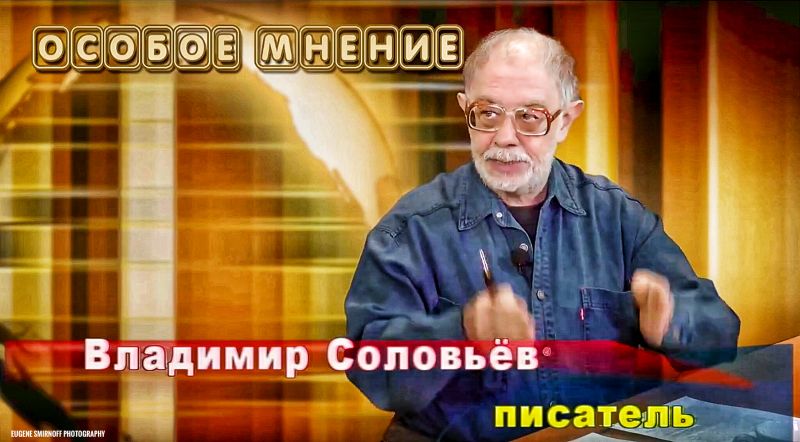
Владимир Исаакович Соловьев – известный русско-американский писатель, мемуарист, критик, политолог.
Эта рассылка с самыми интересными материалами с нашего сайта. Она приходит к вам на e-mail каждый день по утрам.