 КОНТИНЕНТ - Новости и аналитика актуальных событий в мире, мнения и комментарии экспертов и обозревателей
In recent weeks, reports have been increasing about intensive military and intelligence activity by Israel and the United States in Iranian territory and the possibility of Kurdish activity in the west of the country. As published on March 5, “The United States is conducting contacts with Kurds, Baloch and opposition groups in Iran in preparation for regime change.”
It was also published on March 5, that the Republic of Azerbaijan was attacked with missiles and drones from Iran. An Iranian drone struck Azerbaijan’s international airport, injuring two people in the city of Nakhichevan. The Azerbaijani government announced that it would consider its responses to a serious violation of its sovereignty.
Although some of the reports are still not fully verified, their very appearance reflects a possible change in the strategic pattern of the regional conflict. If for years Tehran has managed to keep the theaters of war away from its borders through a network of proxy organizations, recent developments raise the possibility that the regional conflict may begin to move in the opposite direction – into Iran’s own territory.
In such a situation, the strategic pressure on Iran no longer comes from just one arena, but from a broad geographical arc that surrounds the country on almost all sides. Iran has tried for years to keep the war away from its borders, but in the Middle East wars tend to eventually come back home.
Iran’s longstanding outward war-export strategy now faces the possibility of rebounding inward, exposing structural vulnerabilities.
For decades, Iran’s security model relied on a central principle: major conflicts should occur as far from its borders as possible. Unlike many Middle Eastern states, Tehran created a system in which the main military confrontations unfolded outside its territory—in Lebanon, Syria, Iraq, or Yemen.
A central element of this strategy was a network of regional allies and proxy forces, most notably Hezbollah. Through this network, Iran created a deterrence mechanism in which pressure on Tehran could trigger a chain reaction of conflicts in other parts of the Middle East—primarily against Israel or the allies of the United States. For many years, this structure remained one of the most stable strategic systems created in the Middle East.
This system is starting to change. Many forces that supported Iran’s regional strategy have weakened. Hezbollah, Iran’s main deterrence force for years, has suffered serious losses in clashes with Israel and must now focus resources on rebuilding its strength.
Meanwhile, Lebanon’s political environment has shifted, with resistance to the organization’s activities rising among diverse groups. Similar patterns appear elsewhere. Shiite militias in Iraq face growing internal political pressure, while the Houthis in Yemen struggle to expand beyond their local sphere. Consequently, Iran’s regional deterrence is gradually losing stability.
The significance of the current moment stems from several simultaneous changes. Iran’s proxy structures are weakening, Syria and Lebanon’s politics are shifting, and the regional balance of power is being restructured. Now, Tehran’s strategic system faces pressure from multiple directions. In these conditions, internal geographical and ethno-political factors may become more important than in previous decades.
Iran’s Ring of Periphery
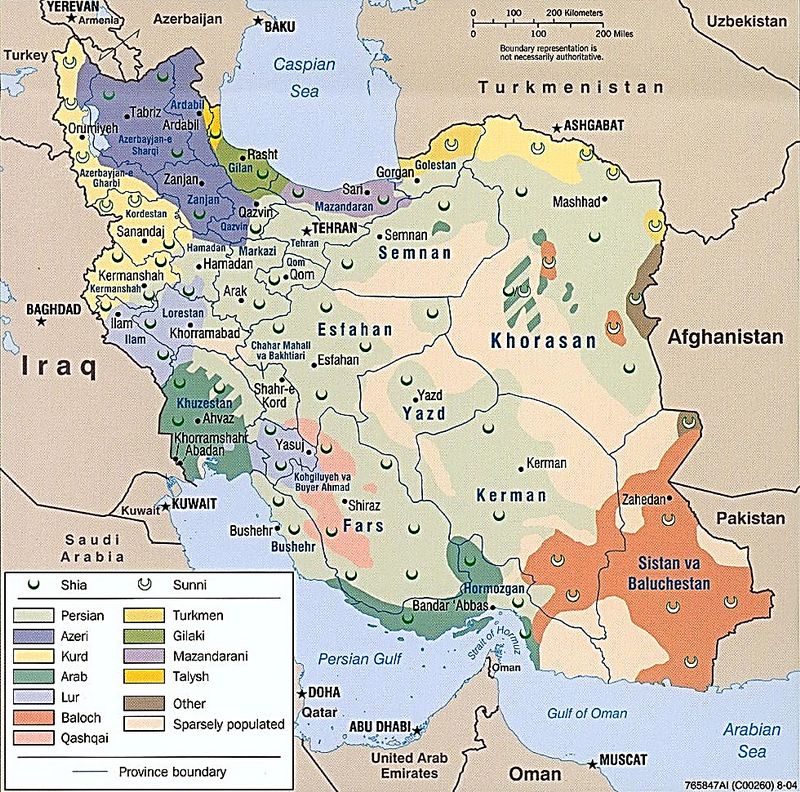
Looking at Iran’s map, one sees important strategic geography. Several regions with strong ethnic identities surround the Persian core: Kurds in the northwest, Azerbaijanis in the north, Arabs in Khuzestan in the southwest, and Baloch in the southeast. Together, these form Iran’s “ring of peripheries.”
As Iran’s external strategic system weakens, a different trend may begin to take shape: potential pressure could increasingly emerge within the country’s own borders. This shift in the locus of strategic concern marks a critical transition toward internal challenges.
These regions differ greatly culturally and politically. Yet Iran’s map shows a key feature: most large ethnic regions are along the country’s outer edge, while the Persian core is in the central plateau.
This geographical structure creates a “ring of peripheries” encircling the country’s center, positioning these regions to exert concurrent pressure on central authorities if specific preconditions align.
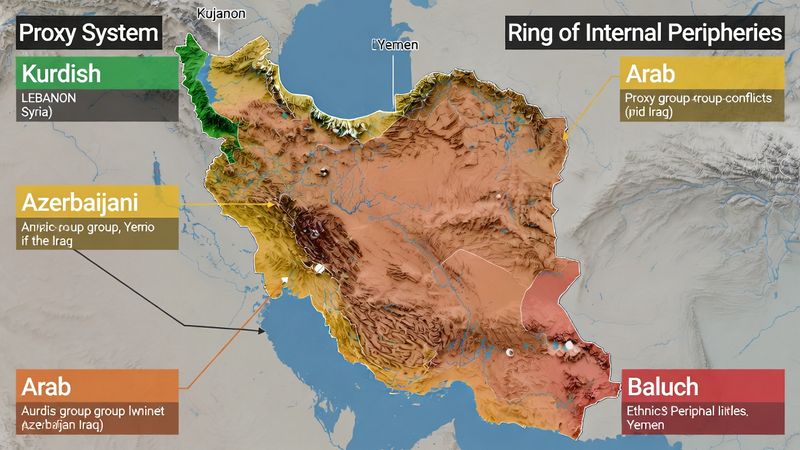
Map of Iran’s strategic structure: the proxy system and the ring of internal peripheries
If political or military pressure arises across multiple regions simultaneously, Tehran may confront its principal strategic challenge from the periphery for the first time. This development exemplifies the dynamics of internal peripheries in geopolitical strategy.
As noted in my 2015 article, most states in the Middle East are relatively new and often artificial constructions, vulnerable to fragmentation when central authority weakens and loses control over ethnic and regional peripheries.i
In some Middle Eastern states, strategic stability depends not only on external threats. It also relies on the structure of ethnic and geographic peripheries. When several of these areas face pressure at once, internal challenges can rival external ones.
Looking at Iran in a broader context reveals a pattern. For decades, Iran built a security system based on an external “ring of proxies”—allied forces and armed groups beyond its borders.
Yet Iran’s geography forms another, perhaps more significant ring—ethnic peripheries encircling the Persian core. If the external proxy system continues to weaken, this internal structure could become the country’s main strategic vulnerability.
The demographic and strategic weight of the peripheries
Demographic factors further increase the importance of these regions. Among all peripheral areas, the Azerbaijani region in northern Iran bordering the Caucasus carries the greatest demographic and strategic weight. Azerbaijanis constitute one of the largest ethnic groups in the country—according to various estimates, they account for between 16 and 25 percent of Iran’s population, or roughly 15–20 million people. Many of them are integrated into state institutions and the national economy. In terms of size, the population of Iranian Azerbaijan is comparable to that of the independent Republic of Azerbaijan.
Kurds control the mountain passes in the northwest. They make up about 8–10 percent of Iran’s population, or around 8–9 million people. This makes them one of Iran’s largest national groups.
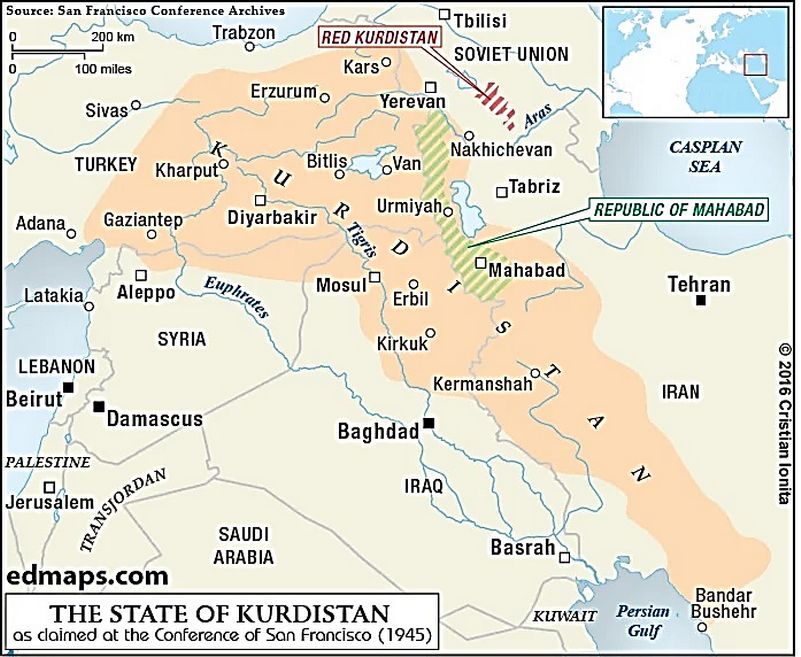
Map of the State of Kurdistan as claimed at the Conference of San Francisco (1945)
At the same time, Khuzestan is an Arab region providing Iran with access to the Persian Gulf. It contains much of Iran’s energy resources—about 80 percent of its oil reserves and 60–70 percent of current production. Thus, Tehran’s stable control over Khuzestan is a key factor in Iran’s energy system.
Baluchistan controls the routes leading from the Persian Gulf through the Strait of Hormuz to the Indian Ocean, as well as the border with Pakistan.
These regions are important not only for ethnicity or politics, but also for strategy. Major transportation and energy corridors cross them, linking the Caucasus, Central Asia, and Persian Gulf with the Indian Ocean and global trade routes.
Together, the peripheral regions form a geographic arc around Iran’s central core. If pressure appears in several regions at once, Tehran could face its main strategic challenge from its own periphery for the first time.
This structure becomes more important when resistance builds up in several places at once. Centralized states can usually crush a single uprising by quickly deploying military force.
If several distant centers become active simultaneously, distributing resources becomes difficult. Security forces are spread thin, supply lines are longer, and it is harder to focus force on a single resistance center.
In these cases, the center might not collapse immediately. Instead, the central authority’s control over the periphery could slowly weaken. Iran’s ethnic geography creates a possible strategic vulnerability.
Within this “ring of peripheries,” the Kurds play a special role. As noted in my 2015 article mentioned above, Kurdish regions in northwestern Iran are geographically connected to a broader Kurdish space extending across Iraq, Syria, and Turkey. For many years, this continuous geographic zone has been viewed by researchers as a potential factor in the long-term transformation of the Middle East’s political map.
For decades, various political and military organizations have operated in this area, and ties with Kurdish groups in Iraq and Syria provide the region with a certain strategic depth. If pressure emerges simultaneously across several peripheral zones, the Kurdish region could become a central element of this dynamic.
Iran’s strategic structure has two concentric systems. More broadly, this pattern exists in regional politics: external pressure can create internal vulnerability. Exporting conflict often brings it back home.
For Iran, the internal system is the geographical ring of peripheries around the Persian core. The external system is the network of regional proxy forces that Tehran has used to project influence in the Middle East for decades. As the external system weakens, the second may gain strategic importance.
There is also an important historical precedent. In 1945, after the Second World War, when Soviet troops were stationed in northern Iran, two national-political entities emerged on Iranian territory. In the north, an Azerbaijani autonomous government was created, and in western Iran, the Kurdish Republic of Mahabad appeared.
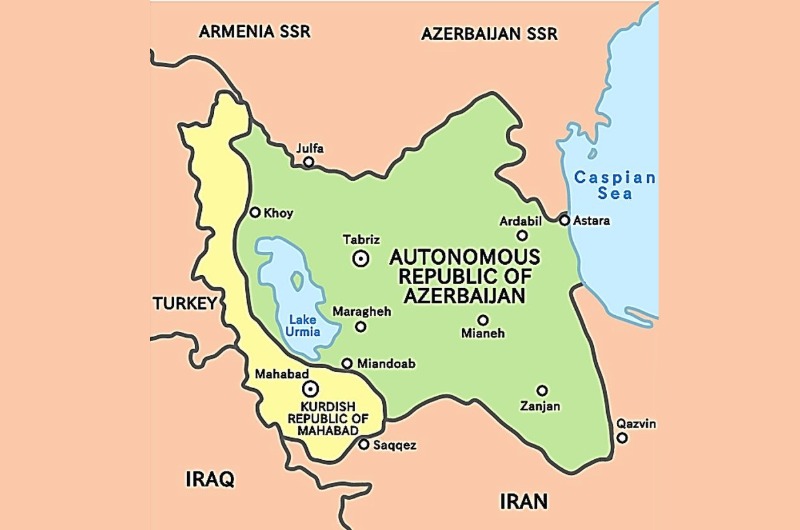
Both structures existed only briefly and were eliminated by Iranian authorities after Soviet troops withdrew from Iran under agreements among the Allied powers at the end of the war. Although the episode was short-lived, the emergence of regional political entities on Iranian territory demonstrates that under certain circumstances, Tehran’s control over the country’s periphery is not absolutely guaranteed.
This episode suggests that when the international environment changes, regional political entities inside Iran may emerge much more quickly than is often assumed. As mentioned in the 2015 article, the region’s history shows that such processes are not unique: state borders in the Middle East have never been permanent and have repeatedly changed under the pressure of political and military crises.
Nevertheless, the existence of local resistance movements alone is usually insufficient to seriously undermine the authority of a centralized state. Throughout history, many regional uprisings failed precisely because the central government could concentrate superior military force and suppress them relatively quickly.
Therefore, the decisive factor is often not the existence of local resistance itself, but the limitation of the central government’s ability to deploy its full military power.
In this context, air superiority becomes especially important. The creation of even a limited aerial “umbrella” could significantly alter the balance of forces. Such superiority could restrict the movement of Iranian forces, complicate the concentration of troops against regional centers of resistance, and create a safer environment for local forces. At the same time, external support—equipment, logistical assistance, and military resources—could strengthen local forces’ ability to maintain their positions.
Looking at the broader regional system, it is clear that such processes never occur in a vacuum. The Middle East often functions on the basis of partial alignment of interests rather than rigid alliances.
Recent experience in Syria illustrates this reality well. Although Russia supported the Assad regime, Israel managed to build a coordination mechanism with Moscow that allowed it to act against Iranian military presence in Syria. This coordination was not based on a political alliance but on recognition of limited yet concrete overlapping interests.
There are also historical precedents of Kurdish contacts with Russia. At various times, Moscow considered the Kurdish factor as one instrument for balancing power in the Middle East. At the same time, the Syrian experience demonstrated that even states with serious political disagreements can build pragmatic coordination when their interests partially coincide.
Such limited convergence of interests also underpinned the coordination between Russia and Israel that enabled Israeli actions against Iranian military presence in Syria.
At the same time, there has been significant cooperation between the United States and Kurdish forces. During the war against ISIS, Kurdish forces became some of the most effective partners of the United States on the ground. Yet when Turkey exerted strong political pressure on Washington, the United States rather quickly distanced itself from Kurdish forces in Syria.
This experience could eventually lead to the emergence of a more complex system of intersecting interests. On the one hand, shared interests could emerge among Israel, the Kurds, and the United States. On the other hand, limited overlapping interests may also exist among Israel, the Kurds, and Russia—particularly in restraining the expansion of Turkish influence across various regions of the Middle East.
Such a structure may appear complex and even paradoxical, yet in the Middle East’s geopolitical reality, flexible systems of overlapping interests often prove more effective than rigid alliance structures.
Ultimately, the strategic system that Iran has built over decades may be entering a new phase. If in the past Tehran successfully shifted conflicts beyond its borders through a network of regional proxy forces, a situation may now emerge in which the main strategic challenge comes from within the country itself.
If for decades Iran’s strategic model relied on transferring conflicts beyond its borders, new conditions may produce the opposite logic. Instead of projecting power through a network of regional proxies, Tehran may face the need to concentrate resources on maintaining stability within its own borders. Such a shift would represent one of the most significant changes in Iran’s strategic position since the end of the Iran-Iraq War.
If this trend strengthens, the region’s strategic logic may gradually begin to reverse.
From Israel’s perspective, the significance of this process is obvious. For the first time in many years, the main source of strategic pressure on Iran might lie not around Israel but within Iran’s own borders. The history of the region shows that such turning points often lead to changes in the Middle East’s political map. Such windows of opportunity appear extremely rarely.
If the Israeli leadership can recognize these changes in the regional balance of power in time and act in close coordination with the United States—while maintaining clear military superiority, especially in the air over northern and western regions of Iran—there may, for the first time in decades, be a real chance for a profound change in Iran’s strategic position in the Middle East.
Such processes were already discussed in the 2015 article in the context of a possible transformation of the Middle East’s political map.
Iran’s strategy of projecting power outward may ultimately turn into a struggle to maintain stability within its own borders. Sometimes the geography of a state proves more enduring than its strategy.
i The brand-new Middle East, by Yakov Faitelson. Published in Hebrew.
The Institute for Zionist Strategies, Jerusalem, March 2015.
Эта рассылка с самыми интересными материалами с нашего сайта. Она приходит к вам на e-mail каждый день по утрам.