Vladimir SOLOVYOV-AMERICAN | EUROPE’S TIME OF TROUBLES, or EYES WIDE SHUT
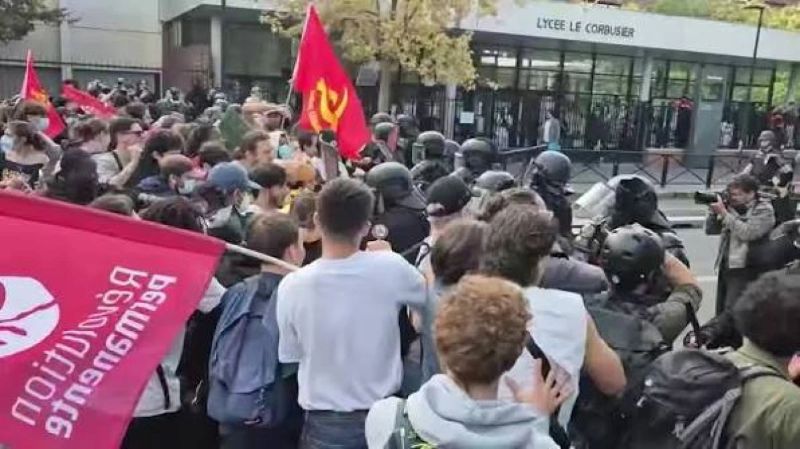
Иллюстрация: скриншот из видео
…A fiery stone in a wondrous nest,
Amid sulfur, amid fire, in the night of the flood,
A flying green star,
My star, my Europe!
—Ilya Ehrenburg, “Europe,” 1943
“At any moment, a double barbarian invasion may descend upon us—from without and from within.”
—Marcel Proust
Though born a Leningrader, I spent my final years in Moscow, and now live in New York with an American passport, I have felt myself to the marrow of my bones a European ever since childhood. Otherwise, why would I have traveled the length and breadth of Europe, first from Russia and later from the United States, far more extensively than I have traveled the States themselves? And why would I have returned time and again to my beloved Italy, the only country I truly feel nostalgic for, staying there for weeks and months at a stretch?
That is why, from across the ocean, from the safety of a distant shore, I am so deeply troubled by Europe’s fate at this very moment, when, at its very heart, in Ukraine, a bloodbath unleashed by the Kremlin’s cretinous autocrat is raging—the bloodiest since World War II—while in other European countries, in ever-growing numbers, we have entered a Time of Troubles of our own. Barbarians waving Palestinian flags are rebelling against our great Judeo-Christian civilization, rioting, rampaging, setting fires, committing acts of violence, and threatening its very existence. Orthodox despotism and Islamic theocracy have converged in a frenzy of violence and death.
They say there are no prophets in their own country. But there are! I am talking about the great Proust, who saw it coming as clearly as if he had gazed into a crystal ball when, a century ago, he presciently warned of a double barbarian invasion—from without and from within.
The difference is that today, unlike in the wars between Europe and the Ottoman Empire, the barbarians are operating from within. They have taken over one-fifth of Ukraine—and France, Italy, and Spain, in their entirety. The fire is spreading, engulfing ever more countries.
I have already written about World War III, which, for the time being, is geographically confined to Ukraine, yet involves, directly or indirectly, by proxy, some fifty countries on every continent save Antarctica. By defending Ukraine, these countries are defending themselves and Europe itself, because we are all in the same boat now—forgive me the cliché. I will go further: Europe is now relying on heroic Ukraine as its shield against the Rashist horde. After all, the only combat-ready army in Europe today, battle-hardened by years of actual warfare, is Ukraine’s.
Period.
There were other prophecies dating from roughly the same era, give or take a century. By way of analogy, I recalled Ilya Ehrenburg’s brilliant dystopia, The Trust D.E.: The History of the Destruction of Europe; and, by way of an analogy to that analogy, Oswald Spengler’s contemporary The Decline of the West. The point being that Europe has been pronounced dead more than once, yet here she is, still alive and kicking—a young old lady, if you will.
For now, at least.
Of course, World War II and the Holocaust exacted a terrible price from Europe. But with America’s help, she rose from the ashes like a Phoenix. The collapse of the Soviet Union was a genuine godsend for Europe, as Eastern Europe and the former Soviet republics returned from Moscow’s captivity to rejoin her.
Then came mass migration, largely from Muslim countries, which threw Europe’s ethnic, religious, and even racial balance into turmoil. As a result of Islamization, white Europeans are on the verge of becoming a minority—a minority in their own continent.
Responsibility for this tragic transformation rests above all with Germany. Through a kind of collective transfer, it converted its historical guilt toward the Jews into liberal masochism, throwing open its gates to a barbarian influx. The newcomers may have arrived under the sign of the crescent moon, but their values remain profoundly alien to Judeo-Christian principles and traditions.
On this point, Trump and his fellow travelers have a point: it is difficult to defend a Europe that refuses to defend itself.
Talk about Eyes Wide Shut!
And then came the sucker punch delivered to Europe by the Kremlin’s overlord when he invaded Ukraine.
One thing is beyond dispute: Russia is waging hybrid warfare against democracies around the world, from Australia to Israel, including the United States. That is why we help Ukraine, directly and indirectly, openly and covertly, despite the “exchange of courtesies” between its leaders and ours, and despite America’s diplomatic flirtation with Russia—which is nothing more than camouflage.
At bottom, what we have is a geopolitical bromance born of mutual necessity: America, Europe, and Ukraine.
The question is, who needs whom more?
As for Russia’s hybrid warfare, I have no doubt that Russia, the Great Provocateur, is somehow behind the current unrest in Europe as well. Provocation is a language the Kremlin’s godfather mastered to perfection at his alma mater, the KGB.
Meanwhile, the multimillion-strong Fifth Column that Europe has allowed onto its soil is asserting its rights while destroying our already much-suffering civilization. Or, to recast the metaphor, I would call it a time bomb—and it has just gone off, turning Europe into yet another circle of Hell, on top of the Ukrainian one.
No, it is not Dante I have in mind, but the English poet and tragic dramatist Christopher Marlowe, Shakespeare’s great contemporary, who was, moreover, born in the same year and competed with him. One need only compare their two Jewish plays: Shakespeare’s The Merchant of Venice and Marlowe’s The Jew of Malta. More than that, long before Goethe, Marlowe wrote The Tragic History of Doctor Faustus. In places, it is every bit as good as Goethe’s.
Let me recount, in my own words, a conversation between its two principal characters. Faustus asks Mephistopheles where Hell is.
“Here is Hell,” Mephistopheles replies. “We have never left it.”
Alas, on this tragic note, I must bring my essay to an end.

Владимир Исаакович Соловьев – известный русско-американский писатель, мемуарист, критик, политолог.
Эта рассылка с самыми интересными материалами с нашего сайта. Она приходит к вам на e-mail каждый день по утрам.