ISRAEL & UKRAINE: A STRUGGLE FOR SURVIVAL
By Vladimir Solovyov-American
New York
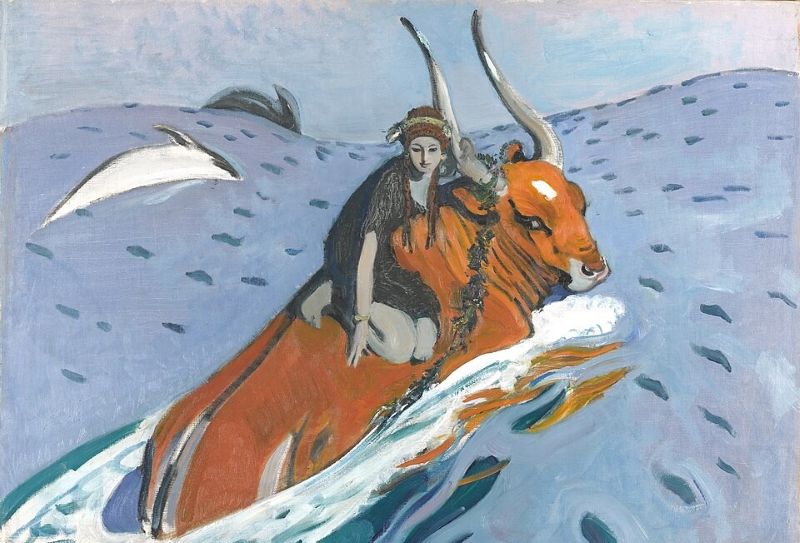
Illustration: The Rape of Europa by Valentin Serov.
There is a world of difference between two things: world history and the perishable currency of day-to-day politics. Even time itself moves differently in each: how slowly it flows—and how swiftly it passes. Two different clocks. Granted, Mayakovsky’s revolutionary poem Our March is tendentious and muddled, but its metaphor of dual time—time as it unfolds and time as it is recorded by history—is dead-on. One stanza alone is worth the entire poem, surpassing it in both meaning and imagery:
Days are an ox, dappled and slow.
The years’ wagon crawls along.
Our god is speed.
Our heart is a drum.
Paradoxical as it may seem, Mayakovsky picks up where Tyutchev left off in his oxymoronic line: “Blessed is he who has visited this world in its fateful moments”—where fateful hardly means happy, and often means quite the opposite.
There are periods in history when, despite all the sensational headlines of the day, nothing of lasting historical significance actually happens. Yet nothing grows stale faster than yesterday’s sensation.
As for us, we have been fortunate—though I use the word without passing judgment—to live in an overwhelmingly historical age, when History is unfolding before our very eyes and geopolitical (I almost said geological) shifts are taking place in the Middle East, Europe, and America.
Naturally, the wheel of history is turned by historical figures, however much they may be creatures of their time. First comes the niche, then the statue. Again, whatever one’s opinion of them: Zelenskyi, Putin, Trump. History will pass its verdict when the stretches of time we now inhabit have condensed into the solid blocks of history.
As Psalm 74:8 puts it:
“But God is the judge: He puts down one and exalts another.”
Does the role of states, nations, ethnic groups, and races change—or does it remain essentially the same?
Take France, for instance. In my view, it left the historical stage back in the last century, never to return. To borrow the rather blunt expression of the great W. H. Auden, France spread its legs before the Germans during World War II—and now, it seems, before Muslims. There was a time, however, when France was ahead of the entire world, a beacon to humanity and a force shaping the course of world history, including the American Revolution.
Meanwhile, the role of Muslims in contemporary history has grown many times over. They have abducted Europe and continue to rape it. The double meaning of the English verb to rape is particularly apt here. How, indeed, should one translate The Rape of Europe? Did Zeus, having transformed himself into a bull, abduct Europa—or rape her? Or was Europa herself not entirely unwilling? And then there is the double meaning of the very name Europa: a mythological figure or an entire continent.
As for the latter, how can America save Europe, which until quite recently did not seem particularly inclined to resist its assailant? How do you save someone from drowning when they seem determined to drown?
And what about the instinct for self-preservation—not individual, but collective?
Alas, history offers plenty of examples of suicidal impulses among countries, empires, and nations. We need not look far: Russia itself has been engaged in a prolonged act of national suicide for nearly five years now, ever since it invaded Ukraine and turned the entire civilized world against itself.
And yet it was America that jolted Europe into accepting its responsibilities and finding the will to resist. The struggle of Judeo-Christian civilization against Islamic and Orthodox extremists is far from over.
I would venture to say that it is in full swing.
More than that, it is existential in nature.
It is hardly accidental that leading Ukrainian politicians, from Kyrylo Budanov to Valerii Zaluzhnyi, repeatedly invoke Israel as an example, holding up the Jewish state as a model and an ideal.
Both countries have been fighting for their very existence ever since their founding.
A reminder: Israel declared its independence on May 14, 1948. Literally the following day, the fledgling state was attacked by Egypt, Iraq, Jordan, and Syria. That is the de jure version. De facto, the entire Arab world had rallied against Israel.
According to demographic estimates of the time, the disparity was staggering—not only in territory but in population: several million Jews against some one hundred million Arabs, give or take.
Yet Israel emerged victorious from every Arab-Israeli war. And now it faces Iran, its principal adversary, together with its Arab proxies and satellites.
Truly, David and Goliath—even if the metaphor has become a cliché.
Without going into the many other reasons behind Israel’s victories, I would point to the principal one: the existential imperative. Here is Golda Meir’s wise observation:
“I shall never forgive the Arabs for making our children learn how to kill them. If the Arabs lay down their arms, there will be no more violence. If the Jews lay down their arms, there will be no more Israel.”
To this we must add the tsunami of Аntisemitism disguised as anti-Zionism—or, increasingly, displayed with its visor up and its true face exposed. Paradoxically, it only demonstrates that the fermenting role of Jews in world civilization has by no means diminished. Nor has the significance of Israel, which remains at the forefront of world history.
By the will of fate—or Fate itself?—a country that had never before occupied the historical stage has now stepped onto it for the first time, fighting, like Israel, for its very existence.
Incidentally, the demographic and territorial proportions between Ukraine and Russia are not entirely dissimilar, even if the comparison is not exact.
David and Goliath once again?
For the same existential reason, Ukraine has not only held its defensive lines for nearly five years; this year it has also gone on the counteroffensive, reclaiming its territories and inflicting heavy losses on the aggressor.
In October alone, Russian forces reportedly suffered nearly 55,000 casualties—killed and seriously wounded—a monthly record since the beginning of the full-scale invasion of Ukraine. And that is without counting the routine strikes against military targets thousands of miles from Ukrainian territory.
Russia, meanwhile, continues to strike civilian infrastructure and civilian populations.
The latest horrific example: at least 26 people were killed when a Russian airstrike hit a school building in the village of Kamyshevakha, in Ukraine’s Zaporizhzhia region, as humanitarian aid was being distributed there.
A scorched-earth strategy?
Why can’t Ukraine respond to the Russian aggressors in kind, an eye for an eye? Why not strike the Russian capital in retaliation for the regular attacks on its own? Especially since Ukraine has the capability: it has already managed to hit two or three military targets in Moscow.
In his Winter Notes on Summer Impressions, Dostoevsky wrote that one could judge the level of civilization of a society by looking at its prisons. I would add a contemporary corollary: one can judge it by the way it conducts war.
A civilized Ukraine is fighting a barbaric Russia.
It all comes down to the level of civilization.
I do not wish to lay everything at the feet of the Kremlin’s leader. But it was he who appealed to—and unleashed—the worst instincts of Russia’s dominant ethnic majority, severing the country from world civilization.
In seeking to destroy Ukraine, he is destroying, first and foremost, his own feudal domain of a country.
That is why Russia has neither a near-term future nor a historical future.
A complete dead end.
Ukraine, by contrast, is acquiring a historic role, leading Europe’s struggle against Russian barbarism.
And what about America’s role? Twice in the last century, in both World Wars, America came to Europe’s rescue.
Today, some are trying to diminish America’s leading role in world history—or even erase it altogether.
Let me invoke two authorities, one American and one British: Mark Twain and Winston Churchill. Both quotations are familiar to virtually everyone, but right now they sound particularly timely and relevant:
“The reports of my death are greatly exaggerated.”
*
“Americans can always be counted on to do the right thing—after they have exhausted all the other possibilities.”
I agree with both authors one hundred percent!
That is why I view the course of contemporary history with cautious optimism.

Владимир Исаакович Соловьев – известный русско-американский писатель, мемуарист, критик, политолог.
Эта рассылка с самыми интересными материалами с нашего сайта. Она приходит к вам на e-mail каждый день по утрам.