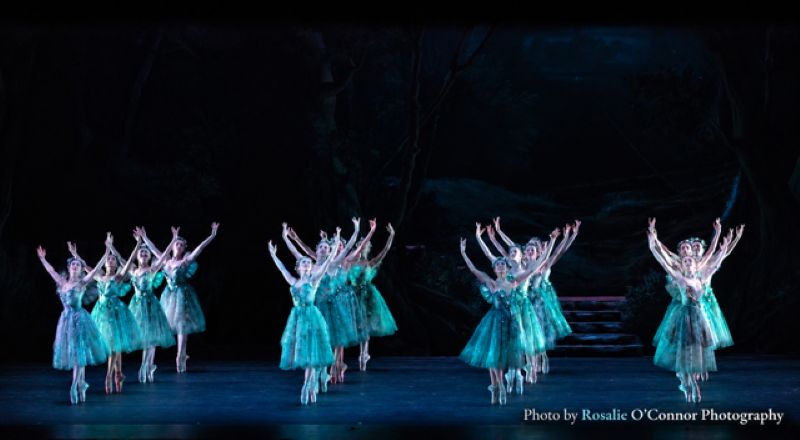
In ballet, there is nowhere to hide; nothing can be concealed. Everything is in plain sight.
Maya Plisetskaya
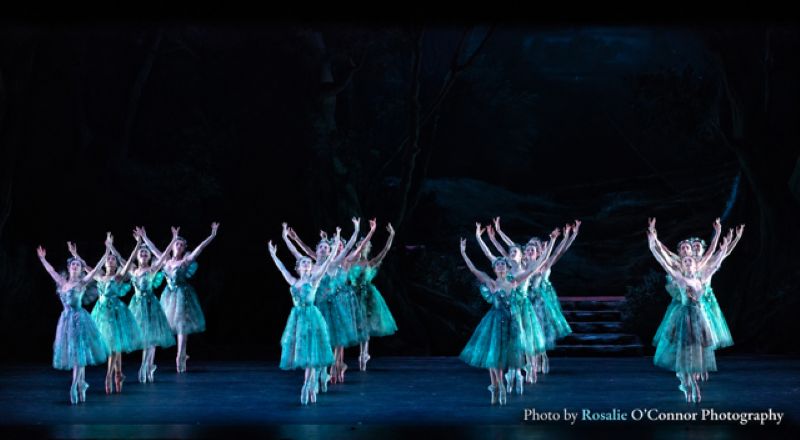
The American Ballet Theatre’s performances are among the most important events in New York’s cultural life. Traditionally, the spring season at the Metropolitan Opera consists primarily of celebrated classical ballets that have remained in the repertoire for many years. The fall season at Lincoln Center’s Koch Theater focuses on innovative and reimagined productions.
Susan Jaffe, ABT’s artistic director, says that the company has always been deeply connected to the classical tradition and its continuous evolution. Since its first performance in 1940, the company has embraced a broad repertoire of new works, new choreography, and new ways of using the language of ballet. This demands extraordinary versatility and technical mastery from its dancers.
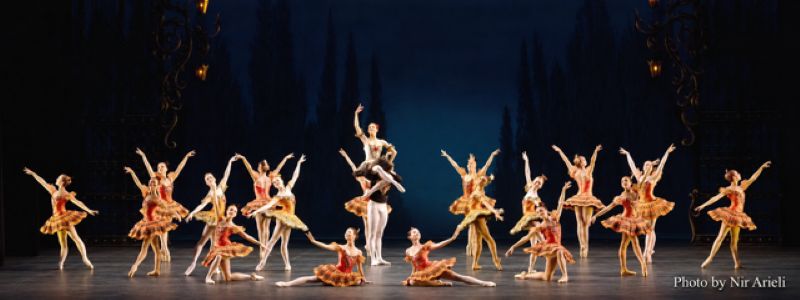
The fall season featured the classics: Natalia Makarova’s Paquita, George Balanchine’s Ballet Imperial, and Frederick Ashton’s Birthday Offering and The Dream. The ballets of Makarova and Ashton demonstrated the company’s highest achievements. Every program also included contemporary choreography. This is not a concession to the times or to fashion, but evidence of a continuous creative search in an art that has already attained perfection. Innovation pushes boundaries, prolonging the life of perfection, preventing it from becoming frozen and turning into a museum exhibit. This task lies at the heart of ABT’s artistic philosophy.
The season included a gala honoring Cynthia Erivo, a star of ballet and film, for her contribution to the performing arts, a dazzling ballet fantasy filled with fairy-tale subjects—angels, fairies, demons, dreams, and visions. The final performance coincided with Halloween, and the evening featured a costume parade and competition.
Audiences greeted every performance with enthusiasm, but critics noted insufficient rehearsal, the monotony of certain numbers, and technical errors: legs held at different heights in arabesque, and other such things. For me, as for most of the audience, these details are of no great consequence. Few people form their impressions of a work of art from reviews. As Plisetskaya said, “The greatest roles are danced with the soul.” Today, from politics to education, there are no authorities. The spectator has only one criterion: whether an emotional resonance arises, whether there has been a genuine experience—or only emptiness and indifference.
I am not a ballet critic, and I have absolutely no interest in dissecting and evaluating every movement. I do not need to read reviews to understand what is good and what is bad. Beside me in the theater is always my life companion, a classical ballerina who spent thirty years onstage, and our impressions almost invariably coincide. She considers ABT a brilliant company, with great choreographers and dancers. The paths to the summits of art, like the paths to love and to God, can and must be different.
For me, a performance from the classical repertoire, tested by time, is always a great event. In art, I am even more conservative than in politics. Better a hundred times Bach, Beethoven, Schubert, Brahms, Mahler; twenty times Swan Lake, Giselle, Don Quixote—than the creations of the heroes of the brave new world of postcolonialism and multiculturalism.
This season, almost everything set to the music of Bach, Mozart, Mendelssohn, Tchaikovsky, Minkus, Glazunov, and Rachmaninoff demanded the highest level of mastery and was magnificent. But at the premiere of Petal, set to the monotonous, lifeless, colorless, deafening music of Philip Glass, whom I profoundly dislike, there was only one thought: when will it end?
I was interested to learn that choreographers love Glass, while ballerinas hate him. Alfred Adler, Michel Foucault, and Theodor Adorno, supreme experts on questions of power and domination, would say that Glass gives choreographers a unique opportunity to demonstrate their dominion over ballerinas.
But Mercurial Son, choreographed by Kyle Abraham to music by Grischa Lichtenberger, a nonacademic composer, was a radical mixture of fractured rhythms and manipulations. It displayed fantastic technique, dynamism, expression, a visual bacchanalia of color, and left an overwhelming impression.
An important event of the season was the premiere of Trio Élégiaque, created to Rachmaninoff’s music by the youngest choreographer in ABT’s history, twenty-one-year-old corps de ballet dancer Brady Farrar.
At the same time, Balanchine’s promising Ballet Imperial, set to Tchaikovsky, was no great event. It was 001, an introduction for beginners seeing ballet for the first time. The main thing is not to frighten them: show them something easily accessible, without demanding great emotion or reflection.
Classical ballet, if it remains genuine art, however much one attempts to modernize and democratize it, belongs to the realm of elite art, of high culture. As Alexei Ratmansky says and demonstrates, one may turn to any innovative form, but first one must learn to dance: acquire genuine mastery, undergo years of rigorous training—from the age of six until the end of one’s career—and work with outstanding choreographers and partners.
In America, only 2% of the population attends a ballet performance even once a year. The average age is around sixty. People pay thousands of dollars to see a fashionable rapper or Taylor Swift. A hundred dollars for phenomenal classical art is considered expensive.
But as in every sphere of human activity, a small proportion of people capable of creating, understanding, and appreciating excellence is enough to establish the highest criteria, standards, and achievements, and to ensure the preservation and development of tradition.
Louis XIV, Madame de Pompadour, Catherine the Great, Marie Antoinette, Ludwig of Bavaria, the Duchesse de Guermantes, Prince Yusupov, Jacqueline Kennedy, and Princess Diana would, in our time, be seated in the boxes and front rows, both at classical performances and at premieres. I would not venture to judge what they might think of fundraising galas and the names of nouveau-riche sponsors displayed on theater façades and in their foyers.
Throughout almost the entire history of civilization, art aspired to eternity, to become a window onto the world, to serve spiritual enrichment and divine purpose.
Today, art aspires to go viral. What matters is attention, here and now. There is an abundance of politicking and demagoguery, while responsibility, meaning and significance, shame and conscience have been abolished. Provocation, shock, and scandal have replaced mastery. The absence of talent, training, and professionalism is no obstacle to appearing onstage or exhibiting in a gallery. Publicists and producers will promote it and sell it.
Contemporary ballet is not immune to all this. There are countless dance companies capable of everything except ballet. Yet the canon of ballet remains unshakable.
That canon rests not on fashion or taste, but on the God-given, natural, spiritual, and physical capacities of the human being. Classical ballet is law and form, relentless labor, discipline, and responsibility. Break these laws, abandon them, and it is no longer ballet.
Without beauty, magic, intense emotional experience, the correct position, a leap that defies gravity, a magical line, thirty-two fouettés—it is not ballet.
Of course, ballet has changed enormously since the days of Louis XIV and XV, Ludwig of Bavaria, and Nicholas I. Choreography has grown more complex, musical and artistic production more sophisticated, professional mastery and technical possibilities more advanced, while the repertoire and audience have expanded.
The theaters and palaces of the Renaissance and Enlightenment never knew artists of the caliber of Anna Pavlova, Galina Ulanova, Maya Plisetskaya, Natalia Makarova, Diana Vishneva, Margot Fonteyn, Alicia Alonso, or Sylvie Guillem.
In royal theaters, ballerinas shone, while men played supporting roles. Vaslav Nijinsky, Erik Bruhn, Rudolf Nureyev, Mikhail Baryshnikov, Vladimir Vasiliev, Alexander Godunov, Valery Panov, Yuri Soloviev, and Maris Liepa transformed our understanding of ballet. Onstage, equality and harmony between the sexes were achieved.
At Versailles, the chief choreographers were the Louis themselves. The modern era brought Marius Petipa, Michel Fokine, George Balanchine, Frederick Ashton, Yuri Grigorovich, Leonid Jacobson, Maurice Béjart, Natalia Makarova, and Alexei Ratmansky.
One cannot fail to notice that Russian names dominate this list of the great masters of ballet. Yet the entire history of Russian ballet is filled with tragedy, with artists denied the freedom to express their creative aspirations, forced to bend under the weight of autocratic and totalitarian control, or to seek refuge beyond their country’s borders at enormous personal risk.
Art, like all creativity, is full of contradictions. Harsh conditions, control, and dictatorship compel people to seek spheres in which some degree of independence remains possible. In Tsarist Russia and the Soviet Union, outstanding achievements were made in ballet, classical music, mathematics, and chess, largely because in these fields the development of talent and creativity was not subjected quite so strictly to Party supervision.
The Red Poppy, The Limpid Stream, Flames of Paris, and The Bolt were officially classified as “heroic-patriotic ballet.” The librettos, stage designs, explanatory notes, and reviews complied with the prescribed requirements and rules, but the notation of dance, the dancer’s body and movement, were not determined by Party directives.
Under present conditions, masters of dance have little reason to worry about restrictions on their creative freedom. The culture of revision and cancellation has affected classical ballet less than other arts. Yet there have been noticeable changes: men dance women’s roles, women dance men’s roles; there are no racial restrictions in casting; avant-garde music is used alongside the classics; and countless stage effects once unimaginable are now available.
There is freedom to criticize both the outdated repertoire and the headlong rush toward innovation, a rush that may soon leave us with no one capable of dancing Odette or Giselle.
Yet even at the most rarefied heights of ballet mastery, the principal concern is financial. An innovative production can be brought to the stage in a month. A full-scale classical ballet represents ten years of work. Seventy percent of box-office revenue comes from Swan Lake, The Nutcracker, The Sleeping Beauty, Giselle, and Don Quixote.
Renewal is necessary, as are experimentation and the invitation of stars from around the world. The free market and financial self-sufficiency are utopian notions for classical art, while government and municipal subsidies do not cover even a small fraction of the costs. Hope rests with sponsors, who have their own tastes and notions of beauty and eternity. Begging an oligarch for money is not much more pleasant than begging a king or a ministry of culture.
High art exists within society and cannot escape the conditions of its existence. But ballet is the most honest art.
In literature and journalism, as in politics and ideology, there are no limits to falsehood. There is no boundary between information, analysis, and propaganda.
In painting, manipulation, charlatanism, and pathology prevail. A visitor wanders like an idiot through a contemporary exhibition, surrounded by works valued at millions of dollars, ashamed to reveal his disgust. If you do not understand, you must be stupid, uneducated, incapable of appreciating what is before you. Your problem.
In contemporary architecture, a seventy-story glass box that disfigures its surroundings is presented as the supreme expression of progress.
In popular music, savagery, chaos, absurdity, shock, the exploitation of eroticism, and brain-shattering decibels have become the principal means of expression and the conditions of success.
Classical music, too, has no immunity to falsification and manipulation. The ordinary listener cannot distinguish a genius from a clever showman. Technique, tricks, extravagant appearances, and flamboyant costumes often replace profound aesthetic and intellectual exploration in composition and interpretation. All this innovation can already be replaced and surpassed in its effects by artificial intelligence.
In ballet, emotional emptiness, falseness, and professional imperfection are immediately visible and unforgivable.
Everyone dances, many with considerable skill, and robots can do it even better. But none of that has anything to do with ballet. Nijinsky’s flight, Nureyev’s tiger-like grace, Vasiliev’s steel-strong lifts, Baryshnikov’s leap, Pavlova dying, Ulanova’s soul, Plisetskaya’s arms, Fonteyn’s poise and balance, Maximova’s dramatic mastery—none of these can be imitated or copied.
The level of mastery is apparent both to the professional connoisseur and to the ordinary spectator. No theories of equality, inclusivity, diversification, representation, past traumas, grievances, or injustices are admissible here. Ballet is always a moment of truth.
One of the great problems of the modern world is that there is no one left to trust. There are no prophets, no authorities, no faith, no ideals. Only 17% trust the government and the justice system; 28% trust the mass media; 17% trust business; 33% trust religious institutions; and 27% trust schools. These figures are catastrophic and shameful, and they reflect a long-term trend. Fifty or sixty years ago, trust in the most important institutions stood at around 70%. And there is not a single issue of public importance on which citizens can agree in their interests and opinions. Social and partisan divisions only grow deeper.
But at a performance by a great ballet company, you will not be deceived. Here, the stage and the audience are united by the highest values: beauty, creativity, talent, and perfection. Everything else recedes.
Classical ballet today is the orchestra aboard the sinking Titanic of Western civilization. It plays to the very end, every note flawless.
Эта рассылка с самыми интересными материалами с нашего сайта. Она приходит к вам на e-mail каждый день по утрам.