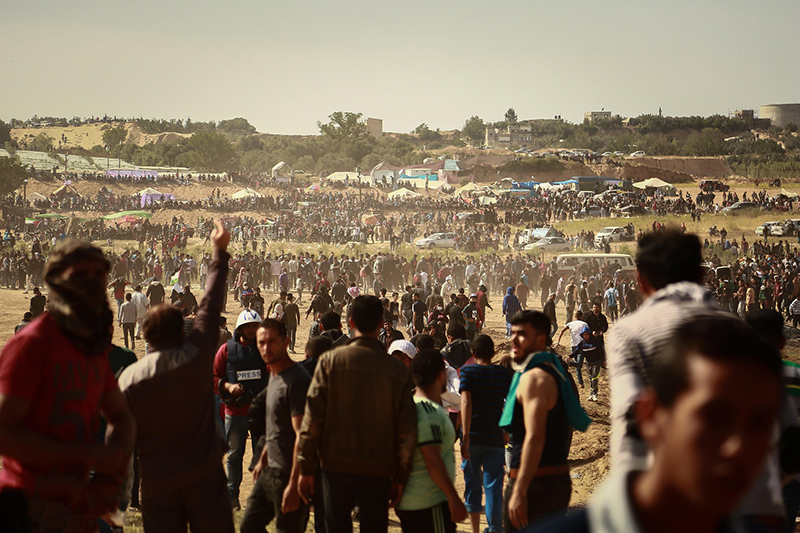
Do not profit from the blood of your neighbor.
Leviticus 19:16
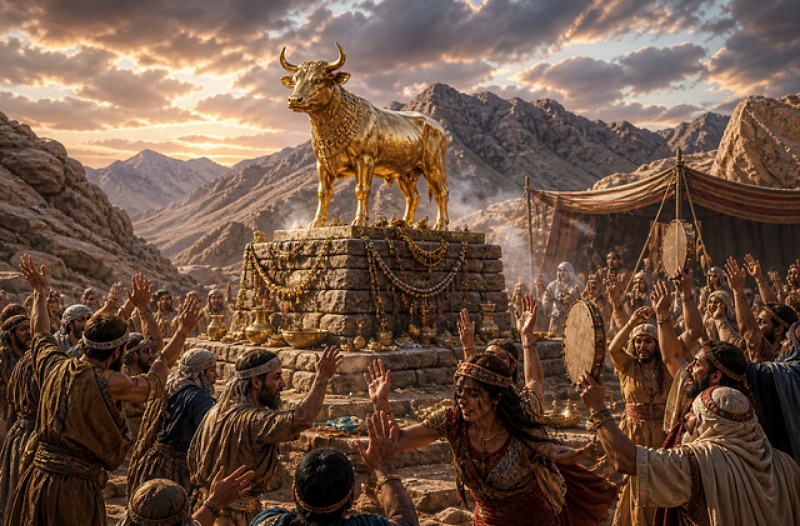
Иллюстрация: kontinentusa.com / AI
The Price of Life
The tradition of paying compensation for murder was, in its time, a step forward, as it replaced the previous, more brutal custom of blood feuds, which could continue from generation to generation.
“Blood money” became widespread in Islam as an alternative to the death penalty or revenge by the victim’s relatives. The standard payment was 100 camels. If the murderer was poor, the entire community paid. The tradition has survived to this day in some Muslim countries.
In ancient Israel, blood money was strictly prohibited. However, if the killing was unintentional—such as a bull goring a neighbor or a building collapsing due to negligence—monetary compensation was permitted.
The concept of blood money has acquired a broad metaphorical meaning. It characterizes actions and intentions to gain an advantage—financial, political, status-related, or competitive—through cruel, immoral means. The concept is actively used in political struggles and propaganda to discredit an opponent. The proletarian writer Maxim Gorky asserted: “There is a drop of blood on every dollar”; “All money is blood money,” says the protagonist of the bestseller Lorenzo Carcaterra.
The causes of wars, bloody conflicts, expenditures on the military-industrial complex, and related interests are particularly often considered in discussions of blood money. People who do not know the names of Goethe, Gounod, Faust, and Mephistopheles know lines from the opera’s arias: “The calf of gold is atandingstill, The world adores his power”, “Satan leads the dance”. Perhaps no quote is as widely known as the ancient Roman principle of Longinus and Cicero: “Cui bono? Cui prodest?” — “To whose benefit?” Police investigations, political debates, detective stories, and everyday thinking are built around this approach.
The concept applies to various eras: slavery, serfdom, colonization, imperialism, labor exploitation, concentration camps, plundering of national wealth, oligarchy, bureaucratic corruption, forced prostitution, organized illegal immigration, the drug trade, and arms dealing. Just as in the bygone era of wars for gold, the struggle for oil has been elevated to the geopolitical concept of “business on blood,” where human lives are expendable.
Opponents of private medicine, the pharmaceutical industry, and insurance see this business as an example of profiteering off human suffering. Record-breaking costs, ruinous payment systems, the COVID-19 pandemic, and the medical lobby’s influence on politics have reinforced these perceptions. Luigi Mangioni, who shot the CEO of UnitedHealthcare, has attained the status of a folk hero in the eyes of many Americans.
Financial bondage—this is how banks, credit companies, and the system of buying and renting housing are often viewed. The average American family debt is $150,000; nationwide, it’s about $20 trillion. The average rent is one-third of income; when buying, it’s over 30%. In a big city, it’s often 50% for the middle class, yet it’s more profitable to build a tenth apartment for a billionaire than a hundred for a young family.
America has the most expensive legal system. There is equality before the law, but the “public defender” studies the case on the way to court; corporations and the wealthy can spend many millions and have a team of dozens of professionals. With significant resources, a criminal charge often ends in an out-of-court settlement for compensation, with a non-disclosure agreement.
Total computerization, life on social media, the shadow economy, and cryptocurrency have brought about an unprecedented rise in crime, extremism, and radicalism, sexual deviance, and psychological disorders. The most common crimes are identity theft and property loss. Corporations and the wealthy reap unprecedented profits and can protect themselves, but the pensioner, ill-equipped for this brave new world, is the first victim. Even more problems are created for children, whose lives from an early age are built around phones and video games.
Socialism, like all regimes built on blood, has been rejected by history and human nature. But the kingdom of the golden calf—even if you call it liberal democracy—is neither an excuse nor a solution: “You cannot serve both God and Mammon.” Universal chaos and agony bear witness to this.

War on All Fronts
Political struggle is always a reflection of a clash of interests. The arsenal of methods includes media witch hunts, smear campaigns, character assassination, invasion of privacy, the use of the judicial system to discredit opponents, and much more.
The vocabulary of existential and religious wars, class struggle, and the criminal underworld has entered everyday discourse. To his enemies, Trump is a fascist, Hitler, a dictator, a destroyer of the country, a financial criminal, a racist, a sexual predator, an agent of foreign influence, and a dangerous mentally ill person. This vocabulary is used by high-ranking politicians, well-known media and cultural figures.
Among them are Congress members Elizabeth Warren, Adam Schiff, Ed Markey, Ayanna Pressley, governors Josh Shapiro and Joseph Pritzker, New York City Mayor Zohran Mamdani, and his fellow progressives. Former FBI Director James Comey posted his artwork online: a seashell arrangement on the seashore, 86–47; 86 is slang for “elimination,” 47 refers to Trump, the 47th president. Jimmy Camel, an ABC personality, joked: “Mrs. Trump, you’re glowing like a young widow.” Melania Trump called this crude humor “hateful and violent rhetoric.” Did he apologize, repent? He cited free speech and the public mood in America.
Cole Thomas Allen, who attempted to assassinate the president at the Correspondents’ Association dinner—a graduate of a prestigious university, a teacher, and a Harris donor—called Trump a pedophile, a rapist, and a traitor. These are terms from the lexicon of liberal propaganda, which portrays the president as a client of Epstein, a sexual predator, and an agent of foreign influence.
The media has become a tool of propaganda, an active participant in partisan struggles, but above all, it is a colossal business with a budget of over one and a half trillion dollars. Content sales and revenue are subject to market forces. They sell what sells. Stirring up passions, conflicts, and scandals increases viewership and profits. It is a vicious cycle from which logic and conscience cannot extricate us.
In today’s America, there is no Walter Cronkite, no Walter Lippmann, no Tom Brokaw, no Larry King. Instead, there are opinion leaders like Tucker Carlson, Candace Owens, Joe Rogan, Hasan Piker, and many others like them. They have the largest audiences and the highest revenues, and their numbers are growing.
Tucker Carlson has become the most sought-after influencer. On FOX, he built his audience by defending traditional white America against liberalism and illegal immigrants. He had 4.5 million viewers. When Israel and Zionism became the dominant themes of his programs, his interviews are watched by hundreds of millions in many countries. Paranoid syndrome and fanaticism are secondary here; the main thing is the commercialization of anti-Semitism. The cult of violence is more profitable than sowing what is reasonable, good, and eternal.
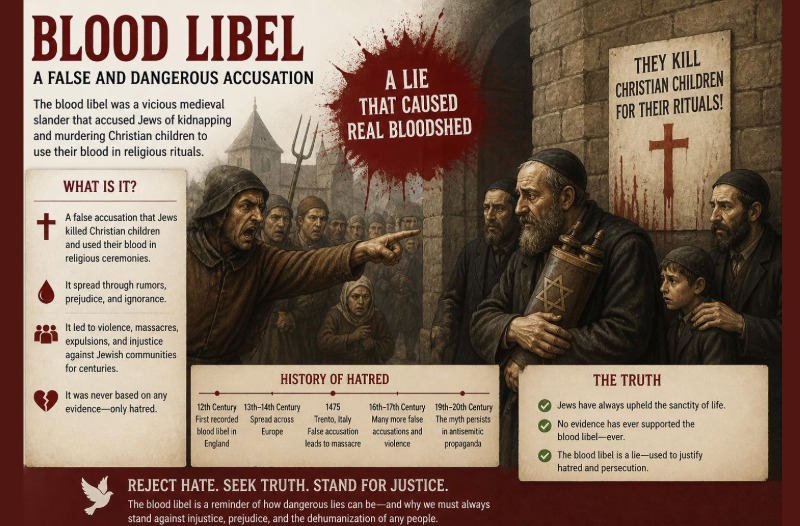
Иллюстрация: kontinentusa.com / AI
Blood libel in the age of progressives
Blood libel has a centuries-old history. Originally, it was the accusation that Jews used children’s blood for ritual purposes. The myth was used to justify violence, persecution, and pogroms against Jews. Medieval obscurantism has survived and taken root in our time in a wide range of slander—the spread of epidemics, conspiracies by financiers and doctors, the use of organs from living people, the provocation of wars, genocide, pedophilia…
People from the Soviet Union remember the “Doctors’ Case,” in which doctors were accused of conspiring against the party leadership, deliberately mistreating Stalin, and carrying out orders from Zionist organizations. Many were arrested, tortured, and dismissed from their jobs; Jews were being prepared for mass deportation to Siberia, and everyday anti-Semitism compounded state-sanctioned anti-Semitism.
In 1993, Pravda published an article titled “The Satanic Tribe,” accusing Lubavitcher Hasidim of murdering three Orthodox priests on the eve of Easter and attempting to smuggle out of Russia books from Rabbi Schneerson’s library containing “instructions for ritual murders.” The next day, I published an article in Izvestia titled “Satanic Games in Pravda.” The main party newspaper accused me of libel. After lengthy proceedings involving the Russian and American presidents, the prosecutor’s office, and the court, Pravda published my article “Ignorance Is a Demonic Force,” acknowledged that I was right, and, it seems, for the first time in its history, apologized.
It was impossible to imagine that bloody slander would resurface in a liberal democracy. It is no longer enough that Jews control the government, the media, and finance. Today, millions of people are reading and hearing that the October 7th incident was a Mossad provocation, Netanyahu dragged Trump into plans for a profitable takeover of Gaza, a war for oil in Iran, Israel wants to rebuild the Temple on the site of the mosque—this is the plot of Chabad, which organized the war between Russia and Ukraine; Palestinians are being herded into concentration camps and subjected to genocide; Epstein is a Mossad agent gathering compromising material on the elite; Kirk died because he criticized Israel, and this is a warning to Trump and all critics; and the Talmud considers non-Jews to be animals.
The evil of the world is no longer just Israel and Zionism, but all of Jewry. No conspiracy theory is complete without Jewish involvement. There has not been such paranoia in the West since the days of Luther, Voltaire, Wagner, Carl Schmitt, the “Protocols of the Elders of Zion,” and fascism.
Powerful tectonic forces have converged: mass dissatisfaction and resentment among the lower and middle classes, fierce partisan strife, interethnic tensions, a shift in America’s priorities and role in the world, and the rise of radical ideologies. Bitterness and ignorance are seeking outlets. Under these conditions, many have an interest in shifting attention away from real contradictions toward false targets. The memory of millennia, which shaped the archetype of the greedy, cunning Jew, has once again become relevant.
For Jews, a new “second law” has replaced the Torah’s Deuteronomy, (Literally Second Law). Though they make up only 2% of the population, they account for more than half of all hate crimes. Most incidents go unreported. What is unequivocally classified as a violation of the law—harassment, threats, slander, stalking (obsessive pursuit), creating a toxic atmosphere, humiliation, attacks on honor and dignity, psychological terror, and harm—is treated as free speech when directed at Jews. Wearing a kippah with the Star of David—a “baby killer”; supporting Israel’s right to security—support for genocide.
In the citadels of knowledge and civilization—universities, cultural centers—causing a ruckus, disrupting a pro-Israel speaker’s event—is the norm, a civic duty. After a debate on the Israeli-Palestinian conflict featuring Professor Norman Finkelstein, a Jew and sworn enemy of Israel and Jewish organizations, Cornell University President Michael Kotlikoff, a Jew, got into his car, where he was surrounded and blocked by aggressive students demanding answers. While trying to escape his pursuers, he struck a student with his car. The press and social media are on the students’ side. Who will leave the university? I hope I’m wrong.
Following the horrific crime on October 7, contrary to all human expectations, there was an explosion of hostility toward Israel; anti-Semitism took on a global scale and became a powerful ideological and financial asset, a key element of election campaigns. The left successfully capitalized on anti-Semitism; the right could not let this opportunity slip by.
In Jewish history, there have been collaborators, conformists, and those who hated themselves. But this was a small fraction of Jews. Not everyone was capable of heroism and self-sacrifice, but at least there was an understanding of reality—who the friends were and who the enemies were, what gave hope, and what was destructive.
In modern times, socialist and liberal ideologies have swept up the majority of Jews in the Western diaspora, giving rise to utopian thinking about a coming realm of freedom and justice. The Jewish liberal lives in an alternative reality and hopes to re-educate those who seek his destruction through enlightenment and philanthropy.
The question of what to do to prevent another Holocaust is becoming increasingly urgent. Israel stands alone; it is impossible to survive indefinitely under constant threat, sanctions, boycotts, and international pressure. Self-sufficiency, relying solely on one’s own strength, is a utopia. Not even America, with a military budget larger than that of the next 10 countries combined and the world’s most powerful economy, can afford this.
Jewish leaders and diaspora organizations are divided and lack a plan of action. The New York Times published an article titled “In Torment and Agony: A New Reality for Jewish Democrats.” Polls show that about 70% of Democrats sympathize with the Palestinians, while 17% support Israel. Progressives, nurtured by the Democratic Party with Jewish support, are now rejecting that support, deeming it toxic and no longer necessary.
Ram Emanuel, former chief of staff to President Obama, and Governor Josh Shapiro, who are considering a run for president, have renounced military aid to Israel. Many Jews in high-level politics adhere to this moral philosophy. In the recent past, during the presidential election, Republican McCain wanted to choose Democrat Lieberman as his running mate, while Biden and Harris considered Shapiro as a candidate; and although the atmosphere was not as toxic as it is now, they preferred more suitable names. Renouncing one’s heritage will not help one’s career. The ranks of opponents are growing rapidly, their base is strengthening, and they are being supported by the education system, most of the media, generational change, and mass migration from the Third World.
What to do—the eternal question. The revolution of knowledge and information has given way to a paradigm of uncertainty, unpredictability, chaos, and anxiety. Maimonides’ “Guide for the Perplexed,” monographs, and conference recommendations on combating anti-Semitism are of no help.
But here and now, we must think about security. Rabbi Meir Kahane is often mentioned today, but his name has a bad reputation. The FBI designated the “Defense League” a terrorist organization; arrests and bans followed. Today, measures would be even harsher, and even within Orthodox circles, the idea and methods would be condemned. I have great respect for Tablet magazine and its author, Liel Leibowitz. But I was surprised by his article, in which he suggests that people come to synagogues with a gun in their bag for the siddur and tallit. His son is 12 years old, and he is introducing him to weapons. This is yet another utopia. Armed self-defense without cooperation with the police will create more problems than it solves.
The solution is already here; we won’t have to wait long. Artificial intelligence has provided the answer. Not from a database of algorithms, but practically acting. “The technology will depress economic mobility, exacerbate inequality, while ferrying power and wealth to the AI companies and the existing owners of capital.” (Jasmine Sun, Silicon Valley expert). This is not a fringe opinion, but an obvious and acknowledged fact. The process is unstoppable; global competition will not allow to drop out of the game or slow down the pace. Millions across all social classes will become the underclass, their experience and knowledge rendered useless. The process will affect not only manual and office labor, but no less so teachers, journalists, accountants, lawyers, engineers, and even doctors; a multitude of professions will disappear. Much of higher education will lose its meaning, becoming art for art’s sake.
You can’t pin the blame on Altman, Sutskever, Zuckerberg, Brin, and Israel. This is a global process; from China to Iran, no one is spared, and no bans will stop it. People will forget about anti-Semitism and “From the River to the Sea.” Mass protests will take place under different slogans. Carlson and Owens will be out of a job; AI will deliver news faster and more accurately, creating more interesting content for all tastes and expectations. Anti-Semitism will no longer be politically or commercially profitable, nor psychologically comforting. The world will inevitably have to solve real problems, more acute and important than the “Jewish question.”
The entire global community will benefit from the clarification of clouded consciousness and the elimination of primitive archetypes. And if the world finds a solution, it will be together with the Jews, not against them. Western civilization is Judeo-Christian. Its core values, worldview, and culture are biblical. Without the Jews, there is no Bible and no civilization. The antithesis of civilization is barbarism.
The Hasidim have a rule of life: whatever happens is for the best; behind outward difficulties lies a higher purpose. The meaning is clear: anti-Semitism is a chimera, a phantom, a false model of the world built on fear of real life, feelings of inferiority, and ignorance—one that cripples and devours the mind and morality of its bearer, leads to the degradation and destruction of society, and poisons the consciousness and culture of entire nations. And the Jews were once again reminded of what they had forgotten—that they are Jews.
Эта рассылка с самыми интересными материалами с нашего сайта. Она приходит к вам на e-mail каждый день по утрам.