Life is the best school, but the tuition is too high.
An aphorism from the Age of Enlightenment.
In the 1960s, during the Thaw, the idea of the “well-rounded Soviet person” emerged in the USSR. Skeptics had their own take: Homo Sovieticus—what kind of all-round development can we talk about if a trip to Bulgaria is the limit of one’s understanding of the world order, Schopenhauer and Nietzsche are only accessible in the professors’ lounge, and Mandelstam and Nabokov are banned?
After the borders opened, 25–30 million people left the Soviet Union and the post-Soviet states. However one might assess this new life, it broadened knowledge and experience, giving rise to a radical shift in worldview, interests, and relationships.
It fell to me to retrain in New York. I was not a student, but a professor; yet my Soviet experience hindered me more than it helped. It was especially difficult to grasp that the student is always right, and that, within the realm of academic freedom, curricula and relationships are built upon an indisputable liberal creed.
The capital of the world opened up vast horizons. Museums, theaters, concert halls—such cultural scale and diversity were impossible to imagine. On the bookshelves in stores lay the full wealth of world knowledge. In libraries, everything was freely accessible. When I asked for Mahler’s 6th Symphony at Tower Records, I was offered a choice of 16 recordings. At universities, lectures, discussions, and conferences featuring leading international experts are open to everyone. You can participate yourself, say what you think, and not worry about the consequences.
I am not exaggerating the importance of spiritual values. It wasn’t intellectuals and dissidents, but supermarkets and malls that finally and irrevocably settled the question of the advantages of the market and capitalism. What was a privilege of the nomenklatura in the Soviet Union is available here to recipients of food stamps and unemployment benefits. You get used to this quickly, and there’s no turning back.
But most importantly—the atmosphere, the dynamism, the energy of New York in all its splendor and squalor. A boundless panorama of types and characters, beliefs, mores, tastes. To stay in place, you need to push yourself to the limit. If you want to move forward, you have to cross the boundaries. What doesn’t kill you makes you stronger. But there are countless casualties. Everyone is proud of their country, their family, their friends, and themselves, and everyone is dissatisfied and unhappy; the city leads in the number of protests—about 900 last year—various conflicts, and the use of psychotropic drugs.
We are united and invincible, yet there is not a single issue on which we can reach consensus or agreement. The whole world envies us, and the whole world hates us. Life in New York is a symbiosis of contradictions and antagonisms. Alongside undeniable merits and achievements, there is everything that is corrupt and unsightly. An open textbook of sociology, political economy, anthropology, and psychopathology. The city does not live by Locke and Mill, Marx and Engels; it has no authorities. Amid chaos and discord, it creates its own norms and relationships, worldview, and ideas.
New York is the richest city in the world; 350,000 millionaires and about 70 billionaires live here. The number of the ultra-rich grows under any government and through any crisis. The wealthy from all over the world own property here. The total private wealth of the city’s residents exceeds 4 trillion. The city’s budget is 115 billion a year. London’s is 25 billion, Paris’s 12. New York’s financial centers account for 60% of global stock trading. This city is the nation’s main vault; Wall Street is a symbol of the global power of financial capital, the driving force behind the economy, politics, and social development.
Ostentatious, wasteful consumption has reached such proportions and manifestations here as history has never known. A gala with $100,000 tickets, dresses costing millions, and “heavy luxury” (slang for expensive jewelry) worth hundreds of millions. The Met Gala is the most prestigious and expensive, the premier ball of America and the entire world. A parade of vanity, profanity, and vulgarity in the genre of high fashion, with paid media PR that lets them feel like kings of the universe, the elite of humanity. Everything is loud and ostentatious—whether through logos or sheer nudity—the main thing is to get noticed and be shown to the world during prime time, so the tabloids and social media explode.
The balls under the Ludovics were more modest, held according to strict rules and behind closed doors, with admission based on title and merit. Bad taste, shock value, and eccentricity were punishable by banishment. These were spectacles of sacred power, performances for oneself, not for others. Theater featuring Molière’s plays. Classical ballet, with the Sun King dancing the role of Apollo. The most lavish sets. Themed masquerades. No pretense; everyone knew their place and role—kings, nobles, the court, and jesters.
Later, after the revolutions and the guillotines, high society tightened its standards and selection even further. De Langer and de Resto in Balzac, Darcy in Austen, Crowley in Thackeray, the Germantes in Proust, the Bolkonskys, the Rostovs, the Oblonskys in Tolstoy would have considered the display of wealth, talk of purchases and prices, the highest manifestation of bad taste, punishable by disgrace and exile. The Duchess of Guermantes does not notice dresses, does not engage in conversations about fashion, but values innate taste, knowledge of art, and the culture of speech. If you try too hard or imitate others, you have lost. Better a crime than a faux pas. Svan, a Jew without titles, was a welcome guest in salons because he possessed impeccable taste and knew art better than the aristocrats.
America lived it up in the Gilded Age. The nouveau riche bought up old Europe wholesale and retail. The mansions on Fifth Avenue, the Van Derbilts’ and Astors’ balls—it was a new Versailles with gold-plated toilets and paintings and sculptures by the great masters. But patrons emerged, opening famous museums and opera houses. And when necessary, Morgan and Rockefeller rescued the nation from economic crises and made state decisions. If they had seen the stars and the setting at the Met Gala, they would have withdrawn their donations from the Museum. The Duchess of Germant would have fainted here. Swann would not have come here for any amount of money, nor would he have been invited.
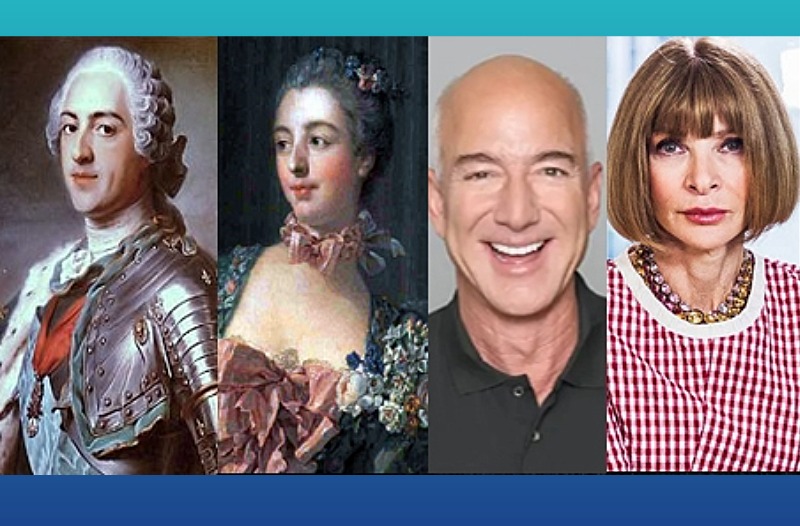
Met Gala is not déjà vu, not a reproduction of the past. Bezos, the gala’s chairman, is not Louis; Anna Wintour, the arbiter of high fashion, is not Madame Pompadour; there is no Voltaire or Diderot in their circle; they aren’t even lovers, which robs the affair of interest and intrigue. The only thing that unites them is, “After us, the deluge.”
The oligarchs, though richer than kings, are not counts or barons, but they can buy a seat in the House of Lords or the Legion of Honor and the Medal of Liberty. They can become the president of the richest and most powerful country in history. The Ludoviks have a dynastic legacy, the Germants have 800 years of lineage, but the new nobility are nouveau riche in both lifestyle and mindset. This is not a copy, not a parody, but a different phenomenon. If the new kings of the universe imitate and envy anyone, it is not the aristocrats, but those who are richer and more in the public eye.
If we compare it to Russian life, it’s the parties of Prokhorov, Abramovich, Melnichenko, and Ismailov. Russian oligarchs used to attend the Met Gala, but now they’re persona non grata. Ivleeva’s “Naked Party” with Sobchak, Kirkorov, Lolita, and Belan became famous. There isn’t much money here, but the point is the same: to outdo everyone else—we’re different, special, the elite. There was a scandal, but that’s always a plus; interest and fees will rise, and they’ve also cast themselves as victims in the fight for rights and freedoms.
Metgala Olympus, the extreme pole of the winners—there are few of them. At the other pole are the losers—there are many of them. These aren’t just welfare recipients; in many ways, this is how the middle class feels—people with qualifications and a desire to work. Many would be satisfied with what they have, but the city’s atmosphere dictates its own ideas about needs and norms, the meaning and purpose of life. That’s why young people have brands and logos, excessive ambitions, yet are perpetually in debt, living in apartments with roommates, in despair and fear of their boss, AI, and layoffs.
In New York, amidst a severe housing crisis, a “billionaires’ avenue” has emerged, where most of the apartments, furnished by expensive designers, stand empty. And nearby, century-old infrastructure, shantytown-like buildings, dirty and dangerous streets and public transportation, unaffordable medical costs, poor public schools, five times more violent crimes than in European capitals, a fentanyl crisis, homeless people, the destitute, people with acute mental disorders without help or supervision, and ethnic and intercultural conflicts. In recent years, noise and fury, anxiety, and protests have become the dominant features of public sentiment and the atmosphere.
65% of Americans believe the country is heading in the wrong direction, and 75% believe their children will live worse lives than their parents. In highly politicized, Democrat-controlled New York, dissatisfaction is even higher. All of this is not so much a matter of class struggle as it is a matter of moral degradation and the psychopathology of the elite. America does not want socialism; that is not the solution. But this is no excuse for Belshazzar’s feast. The nobles drink from the sacred vessels of the Temple, but outside the walls of Babylon stands the Persian army, and on the wall is written “Mene, mene, tekel, uparsin”—Your days are numbered; your kingdom will be divided. In the city—the pinnacle and symbol of capitalism—there is mass rejection of it and the rise to power of demagogues and charlatans with false, unfulfilling promises of a socialist utopia.
Mass dissatisfaction and resentment brought Mamdani and the progressives to power. Before Mamdani, all mayors and their wives attended the Met Gala in tuxedos, but the new mayor refused—a political statement that was met with approval. He proposed to King Charles III that the Koh-i-Noor, a 105-carat diamond in the British crown and a symbol of the empire, be returned. He has many ideas about what to do with the diamonds worn by Gala guests and their owners.
These ideas are shared by Ocasio-Cortez, a Mamdani on steroids. She went to the Met Gala and caused a scandal; her white dress read “Tax the Rich.” Her ticket was paid for by oligarchs. Showing up for free to King Bezos and being rude is cool and wins votes. She is positioning herself for the next presidential election, and her chances are better than Sanders’ or Harris’s. The kings of the universe want to be perceived as the national elite, but they do everything to make themselves hated. Last year, the protests at the Met Gala were only anti-Israel; this year, they were supplemented by calls to boycott the gala, which is funded by exploitation.
Rockefeller, Morgan, Carnegie, and their contemporaries—robber barons and captains of industry—have gone down in history as creators and benefactors. In our time, the CEO of Goldman Sachs says, “We do God’s work,” and this is perceived as arrogance and madness; Tucker Carlson convinces a hundred million listeners that Citibank is more dangerous than Hezbollah and Hamas; the *New York Times* echoes this in its pages, and, put to a vote, the majority would agree with Carlson and swell his audience.
In the era of proletarian revolutions, Gorky spoke of New York as “the city of the yellow devil.” In the Silver Age, F. Scott Fitzgerald wrote: “It is always the city seen for the first time in its riotous promise of all the world’s secrets and all its beauty.” Today, the writer-historian and author of international bestsellers, Olivier Ghez, writes: “The wolf no longer pretends to be a grandmother to get what he wants. The oligarchs no longer hide. They flaunt their power, destroying, exploiting, threatening, and becoming richer than any group of people in human history. They display genuine indifference to the fate of the world and complete impunity.” The author is not a Marxist, but a critic of totalitarianism.
This is not a marginal opinion. It is shared by students and professors at elite universities and participants in the “Black Lives Matter” marches. On this, Jewish liberals and radicals from racial minorities will agree. The Frankfurt School predicted this; it has been forgotten. The new left-wing radicals haven’t read Marcuse, Fromm, Adorno, or Benjamin, but the idea was in the air, took hold of the masses, and became a material force. Will those in power come to their senses? History shows that understanding comes much too late.
Any conclusions and predictions are still utopian, but it is obvious that New York is a remarkable school of life, of learning about the world and about oneself. The city is full of both evil and good. Evil does not always manifest itself through open robbery and rioting; it can be dressed in Chanel and Prada, Patek and Hermès—all in the logos. Good and evil are not always easily distinguishable. To understand the essence of New York’s heated atmosphere, one must look at the extremes. Here, there is both savage, aggressive barbarism and a high civilization that has survived the centuries and offers hope.
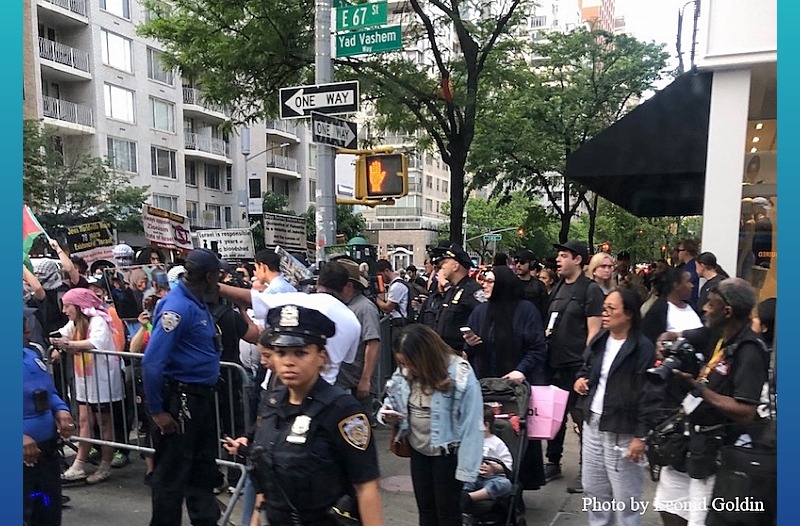
фото автора
We live in Midtown, where protests, parades, incidents, UN sessions, heavy traffic, and everyday chaos create unpredictable conditions for travel and mood on a daily basis; any plans can be disrupted by crowds of demonstrators and police barricades.
This time, we were taking the bus to Lincoln Center for a concert by the American Classical Orchestra; on Lexington Avenue, we were stopped by a crowd waving Palestinian flags; among the participants were also Jews critical of Israel. I have extensive experience attending the bustling events of New York City, but I have never seen such a concentration of hatred and rage. Now it’s not just against the war and the occupation—all of Israel must not exist.
I’ll set aside the emotional state of a Jew who thought he knew everything about anti-Semitism from his Soviet experience and hoped he’d never see anything like this in America. The protest was around Park East Synagogue, where an Israeli real estate event was taking place. There are plenty of such events in the city; land and buildings can be bought all over the world. In New York’s best neighborhoods, the most expensive real estate is bought by Arab princes, Chinese and post-Soviet oligarchs, crypto-billionaires, and pop stars from around the world.
But the attitude toward Israel is different. Last year, a similar demonstration was accompanied by attacks, threats, and insults directed at event participants, the tearing down of barriers, clashes with police, and numerous arrests. No one was convicted; the mayor said there should be no violence, but people have the right to free speech. The new demonstration saw even more violence and hate speech. Under Mayor Adams, a former police officer, there was a police presence near the synagogues. Under Mamdani, the police presence was removed; his rhetoric and actions inspire anti-Semites.
I have known Rabbi Arthur Schneier of Park East since my time in Moscow, when he came to assist Jewish immigrants and meet with Gorbachev and Sakharov. Schneer, a Holocaust survivor, became active in high-level politics and served as a UN Messenger of Peace; presidents and prime ministers, the Pope, diplomats, and city leaders gathered at his synagogue. He is Orthodox but open-minded, and for many years, he tried to build bridges and be friends with everyone. But neither his friends in power nor the police were able to ensure a normal and safe life for his synagogue.
I will try to set aside moral judgments and emotions and describe what I saw in the language of a police report. Demonstrators gathered around the Park East Synagogue. Participants carried Palestinian flags, beat drums, and chanted:
Palestine will never die.
Stop the sale of stolen land.
We don’t want two states, we want all of it.
End the settler Zionist state.
Death to the IDF.
There is only one solution: the intifada revolution.
From the river to the sea, Palestine is Arab.
We will honor all our martyrs, all our brave freedom fighters.
Settlers, settlers, go back home, Palestine is ours alone.
Long live the Intifada.
Resistance is justified when people are occupied.
The New York Police Department, the KKK, the IDF—they’re all the same.
They shouted at passersby and counter-protesters: “Baby killer,” “Pedophile,” “Rapist,” “Zionist trash,” “Nazis,” “Go kill yourself.” Demonstrators displayed symbols that Hamas uses to mark Israeli targets. Vandals desecrated an image of the Lubavitcher Rebbe Menachem Schneerson. Demonstrators attempted to break through metal barriers and advance toward the synagogue. A police officer was hospitalized, and police used pepper spray.
The protest was led by the group PAL-Awda. Also participating were Students for Justice in Palestine, CUNY for Palestine, the Palestinian Youth Movement, the Muslim American Society, Neturei Karta, Healthcare Workers for Palestine, and others.
A few days later, a similar demonstration took place at a synagogue in Brooklyn. There were attacks and scuffles. Head coverings and wigs were torn off. These are no longer isolated, spontaneous protests. The organizers are known, their intentions are known in advance, yet they are not being stopped.
The mainstream media pays little attention; social media platforms support the anti-Semites, who feel like heroes. Congress, the courts, and national celebrities remain silent; Jewish organizations are helpless, issuing empty appeals and declarations.
Courtesy of ACO
New York is the capital of the cultural world. Billionaires, even if only for the sake of vanity and self-promotion, invest enormous sums in cultural projects. Every day in New York, one can hear and see dozens of classical music concerts, theatrical productions, and museum exhibitions; It is a great honor for artists from all over the world to perform and showcase their talents here.
Cultural centers are not ivory towers for the elite; they reflect the spirit of the times, needs and interests, ideological struggles, and demographic changes. Lincoln Center is the most important cultural complex in America and the world. The Metropolitan Opera is the largest opera house in the world; the New York Philharmonic is the world’s finest orchestra; the City Ballet, Lincoln Center Jazz, drama, and movie theaters, the Juilliard School of Music, the Library of Performing Arts, unique architecture, restaurants, and recreational spaces. Ticket prices range from a thousand dollars to free.
The first time I was at Lincoln Center was during a business trip to meet with Isaac Stern; together with the Soviet State Concert Agency, we were preparing the Sakharov Festival. I listened to the Philharmonic with Lorin Maazel, a stunning performance of Mahler’s 6th “Tragic” Symphony. That was my introduction to New York; the impression has stayed with me forever and overshadows everything at the other end of the spectrum.
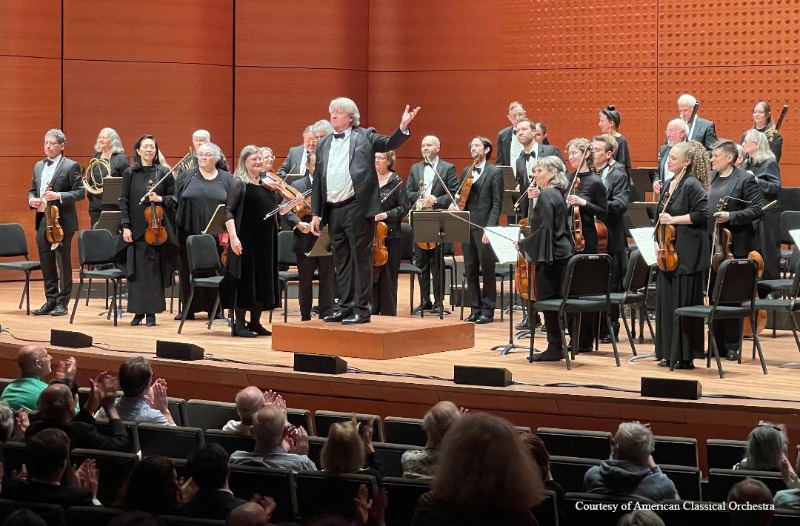
Lincoln Center, like Carnegie Hall, is a celebration that is always with me. For me, these halls are also notable because my life partner performed here for many years. This time, we listened to Mozart’s 17th Concerto and Beethoven’s Third, “Eroica,” Symphony, performed by the American Classical Orchestra in the newly renovated Alice Tully Hall with its unique acoustics. The orchestra is unique in its repertoire, high academic mastery, instruments, authenticity to the period of the works’ creation, and its performance techniques from the 17th to 19th centuries. This is how Mozart and Beethoven’s contemporaries heard music; in the Germant’s salon, only classical music was played; Baron de Charlus performed monumental works without sheet music; and the opinion of the aesthete and erudite Swann was the most authoritative, since he knew and understood music better than the aristocrats.
Thomas Crawford, founder and artistic director of the ASO, composer, conductor, organist, musicologist, educator, and a magnificent storyteller. Music can say more than words; I am skeptical of performers who try to explain the composer’s intentions from the stage, but Crawford knows how to strike the right balance. His pre-performance remarks, vivid and imbued with warmth and humor, delight the audience. He conducts without a score, from memory, demonstrating a deep knowledge of the work and the composer’s creative intent.
The 17th Piano Concerto is one of Mozart’s most famous works; it is full of light, joy, and lyricism. According to the composer’s intent, the orchestra and soloist are equal partners, united by a shared vision and mood; however, in my view, the powerful orchestral sound overshadowed the authentic 18th-century piano.
Soloist Matvey Figel is a laureate of many international competitions; he actively performs in solo and chamber concerts, teaches, and engages in research. Critics and the audience enthusiastically received his debut at Lincoln Center.
Beethoven’s “Eroica” Symphony is one of the greatest creations of Western civilization. The American Symphony Orchestra is small in size, but the symphony sounded powerful, brilliant, and, in my view, even though it has been performed thousands of times, fresh and original. It depicts the struggle of life against death, the victory of light and hope over darkness and despair, profound tragedy (the famous funeral march), and a celebration of freedom and achievement. The symphony defined the boundaries of civilization; it is called a turning point in music history, a manifesto of spirit, dignity, and freedom. The Third Symphony is less popular than the 5th and 9th, but Beethoven considered it his best.
The symphony’s immense public significance also lies in the fact that the composer originally dedicated it to Napoleon. He saw in him a titan, the embodiment of the ideals of the revolution—liberty, equality, fraternity—comparing him to the great consuls of Rome, and regarded him as a hero who was destroying tyranny. He even considered moving from Vienna to Paris. Austria was at war with France, and an enthusiastic attitude toward the First Consul of the Republic, in a country ruled by Franz Habsburg, was an act of civil courage.
But when Napoleon proclaimed himself emperor and renounced the revolution, Beethoven exclaimed in anger: “You are just an ordinary man,” and refused the dedication. Napoleon knew nothing of Beethoven’s drama. He loved opera and Mozart, but for him, music was first and foremost an instrument of power; he gave priority to oratorios and marches.
Classical art, like life, is full of contradictions; it does not fit into schemes or categories and opens up broad possibilities for interpretation. Hitler and Stalin rejected decadence and modernism, valued the classics, and elevated Beethoven to cult status. When a dictator or oligarch patronizes high art or builds a church, this is by no means necessarily evidence of their humanism.
Classical music is the pinnacle of Western civilization. While other spheres of civilization may compare and compete, none can match the grandeur of the Western classical tradition. It is an inalienable heritage that serves as a model for the whole world of God’s design and the perfection of the world and humanity. It embodies cosmic order, the harmony of the universe, philosophical and theological conviction, anthropological perfection, and catharsis. There is nothing higher or greater anywhere else.
The values and ideals of Western civilization are under attack from the lower echelons of a foreign culture and traditions, the left-liberal center, and the upper echelons that concentrate immense wealth, influence, and power. This is particularly noticeable in the spiritual atmosphere of present-day New York, politics and ideology, conflicts of interest permeate all spheres of existence and worldview. For the lower classes, the achievements of Western civilization are the product of a culture of white colonizers, racists, and exploiters. For the upper classes, we can buy and adapt whatever suits our tastes and interests. The lower and upper classes are demonstratively unapologetic, with a complete absence of responsibility, guilt, and shame; the center is riven by division, anger, and frustration, rudderless and adrift, guided by a false compass.
It is often said that conservatives have lost the information war to liberals, religion to nihilism, culture to anti-culture, the traditional family to the alternative family, and Jews to anti-Semites. But it is Western civilization as a whole that has lost the war. The civilization of Aristotle and Beethoven is on a suicidal path and pins its hopes on dialogue and cooperation with those who seek to reject and destroy it. Alarm bells are ringing for Judeo-Christian history, culture, and the future.
The works of Mozart and Beethoven are symbols of emancipation and individual freedom, fundamental archetypes of Western civilization as conceived by God and built by man. This is its universal language, connecting the cosmic and the earthly. Their works have survived the collapse of empires, bourgeois and socialist revolutions, two world wars, fascism and communism, the Cold War, nationalism and multiculturalism, and shifts in political, ideological, and cultural paradigms. They stand against barbarism and savagery, vulgarity and ignorance. They will endure as long as people remain human.
Beethoven has the great life-affirming “Ode to Joy,” and he has the great “Funeral March.” This is the musical expression of the biblical commandment: “Today I call heaven and earth to witness: I have set before you life and death, blessing and curse. Choose life, that you and your descendants may live.”
Эта рассылка с самыми интересными материалами с нашего сайта. Она приходит к вам на e-mail каждый день по утрам.